
The Loch Lomond reservoir on the San Lorenzo River provides much of Santa Cruz’s water supply. Wayne Hsieh via Flickr
SANTA CRUZ – History is an increasingly unreliable teacher for water utility managers. The memory of everything that has gone wrong – floods, droughts, broken pipes, porous levees, unstable dams, or inadequate interties – and the record of how utilities fixed things and paid for the fixes – have traditionally been chapters in the textbook of rules for the future.
California’s coastal Santa Cruz Water Department used the textbook of experience for decades as it gathered water from the San Lorenzo River and small groundwater wells, and stored it in the Loch Lomond reservoir behind the Newell Creek dam. The same lessons applied when treating water at the Graham HIll plant and delivering it though the Newell Creek pipeline.
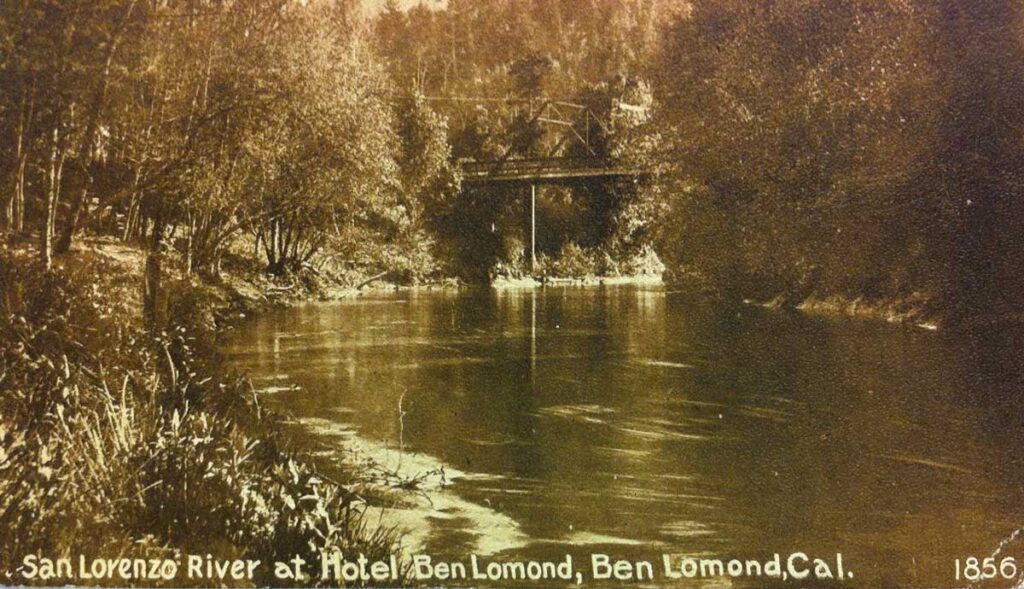
But climactic and political changes are rendering the 20th century textbook obsolete in the 21st century. The need to deliver clean water is the same. The weather, the financing, and the growing threat of unaffordability are not. The efforts the Santa Cruz Water Department is making to update the text parallels work being undertaken by many other utilities.
The agency’s first big challenge of the new century came with the droughts of 2012 to 2014 and the urgent need to keep diminishing water supplies flowing. Reducing demand was crucial. But when usage goes down, so do revenues. So covering the costs of the water system becomes an intractable managerial and political challenge. So does ensuring the affordability of water for customers of all income levels.
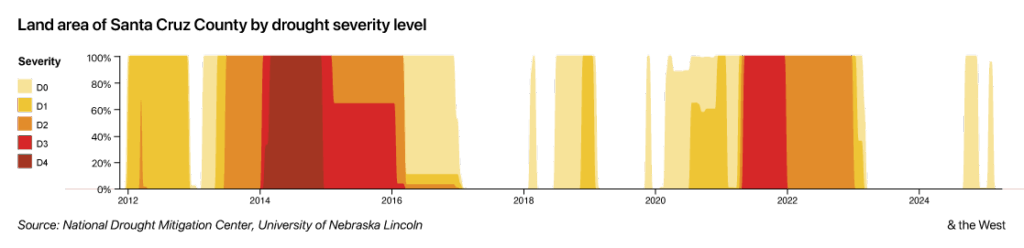
Managers had been jawboning customers about conservation for more than a decade when the severe droughts came more than a decade ago. In 2014 and 2015, the utility allocated water based on a household’s essential needs, promoting conservation by setting higher charges for non-essential water uses like landscaping.
By 2021, water customers had cut their use nearly two-thirds in two decades, to 45 gallons per day.
As Kyle Petersen, the department’s customer services manager, said in an interview, it guaranteed that “a set amount of water was allocated at a basic rate for all customers.” For those who consumed more, the rates per unit of water climbed sharply. Petersen called this “excess use penalties.”
In 2017, the water department changed the rate structure, dropping the allocation process and creating tiered rates that ensured revenue collection is based on the amount of water used, creating an incentive for efficient water use.
It worked. In 2000, total water use in Santa Cruz was 4,380 million gallons, or about 119 gallons per day per capita. This dropped to 87.7 gallons in 2010. By 2021, water customers had cut their use nearly two-thirds in two decades, to 45 gallons per day – one of the lowest per-capita rates in the state.

Conservation by customers is the good news. The growing cost of replacing decrepit infrastructure is the bad news.
Heidi Luckenbach, the current director of the water department, recalled in her February interview with the radio station KQSD. “Back when I started 20 years ago we noticed a very distinctive pattern difference between summer and winter.” Then, she said, customers “cut back on [summertime] outdoor water use” – usually for landscaping and lawns – “across the board.” The 94,000 residents now use, she said, “the same amount of water… as we did back in the 1960s.”
But since most of the water district’s income came from water sales, conservation was a paradoxical success: the department, with a 2025 budget of $46.7 million, has had to raise water prices significantly to cover maintenance of increasingly obsolescent facilities. Now it must figure out where to get $500 million or more needed to renovate an 85-year-old treatment plant, equally old pipelines, and smaller structures tying everything together.
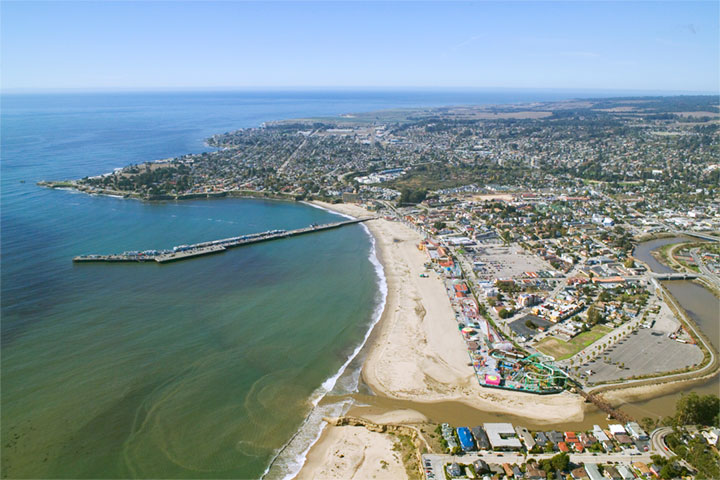
Major dams, aqueducts and pipeline systems throughout the West were built 50 to 100 years ago. Water utilities across the region have to figure out how to pay to update them.
Santa Cruz has company: many western cities face this conundrum. Major dams, aqueducts and pipeline systems throughout the West were built 50 to 100 years ago. Water utilities across the region have to figure out how to pay to update them. The financial straits exacerbated by conservation highlight the problem of long-term costs coming due.
The fellowship of utilities at risk from drought-diminished supplies and shrinking revenues is global. An article last year in Nature, which focused on utilities around the world, reported, “Many drinking water utilities face immense challenges in supplying sustainable, drought-resilient services to households,” and proposed an in-depth risk analysis of the climate and financial challenges facing their sample of hundreds of utilities. It concluded, “The results underline the challenge of attracting the financing required to close the climate adaptation gap for water supply utilities.”
Some utilities see rate increases as the answer. Others changed the way they calculate rates. One common solution: charge one fee for basic water use and progressively increasing rates for excessive use. Santa Fe, N.M. has had this kind of “tiered” pricing since 1997; its per-customer consumption has dropped from 162 gallons per person in 1997 to about 96 gallons today.
About three-quarters of Arizona utilities have these tiered rates, but it wasn’t always easy. In 2021, Tuscon tried to institute tiered rates; a judge blocked it in 2023 after a successful lawsuit from Pima County. The city is just implementing a new tiered structure, justifying the move with a cost-of-service study. Utah this year enacted a law allowing utilities to use tiered pricing. Its capital, Salt Lake City, is expanding its summertime tiered rate system and the city of Provo is moving to follow suit.
California constitution complicates measures to charge heavy users higher rates
In California, it’s not so easy. In 1996, voters passed a constitutional amendment, Proposition 218, requiring that the rate a municipality charges for a service must be related to its actual cost and a user’s proportionate share. In 2015, a state appellate court denied San Juan Capistrano’s ability to use a tiered rate structure, saying, “What Proposition 218 forbids is charging property owners more than the proportional cost of the service attributable to their parcel.”
In 1996, voters passed a constitutional amendment, Proposition 218, requiring that the rate a municipality charges for a service must be related to its actual cost and a user’s proportionate share.
The directive to utilities was to set tiers at levels they could justify by showing the costs are related to delivering the water to a particular class of rate-payers – say, homeowners. A cadre of lawyers and economists are part of a new mini-industry, advising water utilities how to make tiered rate structures comply with Proposition 218.
At the time of the San Juan Capistrano ruling, Santa Cruz’s then-new water district director, Rosemary Menard, was already looking at the mismatch between the reduced income from water sales and the wave of infrastructure repairs coming due. She commissioned a detailed study of the department’s finances. “When I got there [in 2014] our financial situation was kind of on the edge. Having to institute rationing, [made] an already bad situation worse,“ she recalled in an interview.
So far the agency’s tiered rate structure hasn’t run afoul of Prop 218. In 2017 the new structure based 90 percent of the charge on the volume customers used, up from 65 percent. All users paid a $8.78 service fee. Users of very basic amounts – about 500 cubic feet of water – paid $8.43 per hundred cubic feet of water (728 gallons) or $42.15. The rate increased in two more use-based tiers. Ratepayers in the top tier – using at least twice the basic amount – owed at least $80.50 monthly.
Rates have increased substantially in the eight years since then. Santa Cruz’s latest rate schedule means that, in addition to a service fee of $17.89, customers using basic amounts pay $11.10 per hundred cubic feet, or roughly $44 to $55. Customers in the top tier pay $18.21, or at least $182.10 plus the service fee, or at least $199.99.

The city’s conservation culture has meant that an average homeowner uses between 4,000 and 5,500 gallons a month, or about 9 to 34 percent more than the lowest tier limits. The current daily per capita average is 44 gallons. But further south along the coast, in warmer and drier regions, homeowners use more – 56 gallons per day in Santa Barbara in 2024. In San Diego, another region where conservation has been a major focus, it was 112 gallons per day in 2023, down from 235 gallons in 1990.
As the costs of updating half-century-old infrastructure mount, new funding sources are sought
“The … treatment plant cost $1.6 million to construct in 1960. It’s going to cost $158 million to bring it up to date.
Rosemary Menard, former Santa Cruz water director
Rate increases don’t cover the cost of repairs. Menard noted, “the … treatment plant cost $1.6 million to construct in 1960. It’s going to cost $158 million to bring it up to date.” In 2018 the city council estimated a $297 million cost for a basket of major water infrastructure improvements, repairs and additions over the next decade. Debt would underwrite 80 percent of the cost.
In a 2021 update, that cost has risen to about $650 million, 75 percent of which would be covered by borrowing.
The shift to debt financing came, Kyle Petersen recalled, after the 2016 study showed that capital improvement projects were funded “using cash – basically ratepayer monies to pay for assets that would have an 80- or 100–year lifespan.” Spreading the capital investment across multiple generations – all the people who would benefit from expensive upgrades lasting decades – was a central part of the agency’s reasoning for financing capital projects with debt.
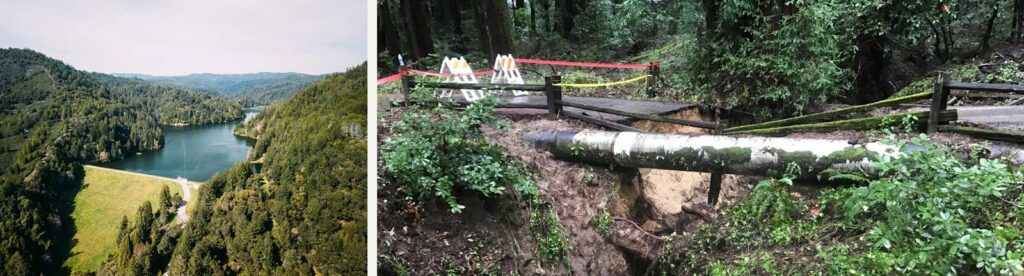
Emergency repairs can’t wait and need to use cash on hand; Santa Cruz maintains a $3 million fund for this In 2023, a series of atmospheric rivers damaged the Newell Creek pipeline which takes water from the Loch Lomond reservoir to the treatment plant, necessitating quick repairs. It was the second break in five years. Now a $38 million debt-financed effort to repair and relocate the pipeline is underway.
Embed from Getty ImagesMenard was determined to ensure that new sources of financing – primarily state and federal loans – were part of the mix. Now, she said, “we’re borrowing 80 percent of what we needed for, first, supply augmentation and second, infrastructure replacement.” Otherwise, she said, the ratepayers’ monthly bill would eventually match a monthly mortgage payment.
Two years ago the federal Environmental Protection Agency awarded the Santa Cruz Water Department a $128 million loan, which the agency had applied for a year earlier. It will be used to help pay for several different projects: improving the Graham Hill Water Treatment plant — a project estimated to cost $158 million – replacing a section of the Newell Creek Pipeline, and expanding aquifer storage.
Loans from California’s revolving loan fund for drinking water could also help defray the cost. These funds originate with the EPA and are distributed on the basis of need, as determined by agency surveys every three years. States usually supplement the federal payments.
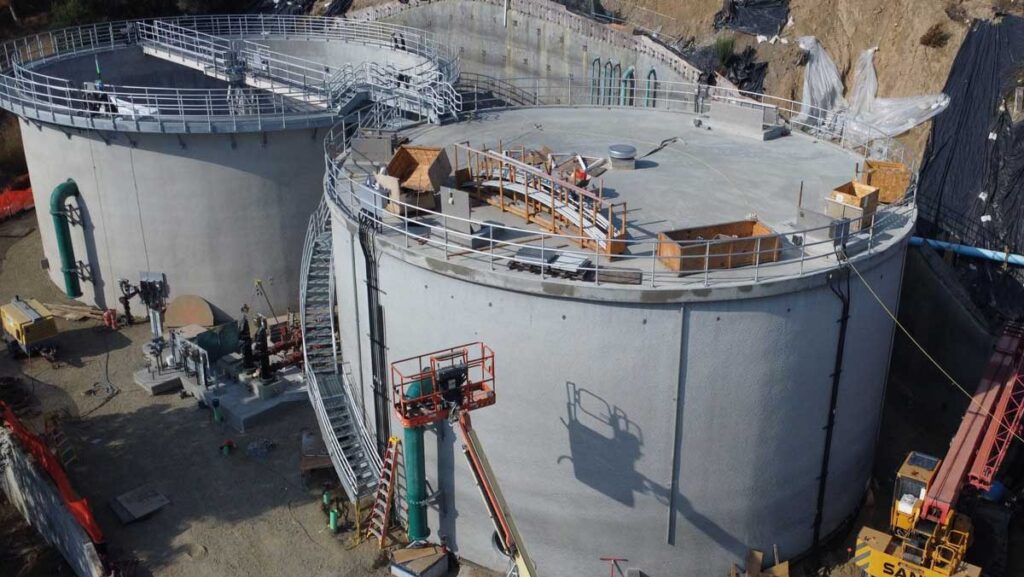
About five percent of the $1.2 trillion appropriated in the Infrastructure and Jobs Act of 2021 is designated for water infrastructure, and $43 billion of this is being distributed through state revolving fund loans. One such loan went to Santa Cruz this year as the California’s Water Resources Control Board confirmed a $50 million loan to help fund improvements to the Graham HIll water treatment plant, where three six-decade-old concrete tanks are being replaced.
Long-term loans ensure future generations share the cost of repairs and replacements
“The advantage of bonds is that you will be able to spread out the cost of the infrastructure over time,” said Barton “Buzz” Thompson, a Stanford law professor and water expert who is one of four authors on a recent in-depth study on the impact rate design has on water affordability during droughts.
He continued, “and what you want to do is to say, ‘Okay, we need to set money aside now because we are utilizing this equipment that is going to be deteriorating and aging over time.’ But many utilities do not do that. So as a result of that, you end up with these very sizable bills suddenly coming due.”
He added, “Santa Cruz is actually probably in pretty good shape. And the reason is that they are large enough that they can actually go out and issue municipal bonds at a really good price.” The department’s debt service costs for 2025 were $7 million, or 15.5 percent of the budget, up from $691,000, or 2.7 percent of the budget a decade earlier.
“Santa Cruz is actually probably in pretty good shape. And the reason is that they are large enough that they can actually go out and issue municipal bonds at a really good price.”
Barton “Buzz” Thompson, Stanford Law School
That money currently comes from ratepayers. Given that, “You really have to look at how prices for vulnerable populations are going to change and how that’s going to stress the individuals’ ability to pay,” said Menard, the former director of the Santa Cruz department.
Droughts can make water more unaffordable. A November, 2023 paper in Environmental Research Letters, on which Thompson was one of four authors, said “Unaffordable water threatens water access in the United States, particularly for low-income households. In water-scarce cities, water shortages during drought necessitate either expensive infrastructure development or costly emergency measures to meet demand, which can in turn increase water rates.”
Kyle Petersen said that credit agencies are beginning to note that “rate affordability is a type of risk.” A 2022 article by the credit rating agency Standard & Poor’s noted: “Many utilities have well-developed lifeline programs and other customer affordability assistance to support customers with their utility bills. While our methodology doesn’t explicitly account for such programs, we’ve observed that well-run programs can improve revenue certainty and stability by reducing delinquency.”
The Santa Cruz agency’s current offer:a $25 credit for low-income customers. Across the San Francisco Bay, the East Bay Municipal Utility District has a fund in place to cover half of low-income users’ service and water-consumption fees, up to 1,050 gallons per month. As of last year, about 10,000 customers had enrolled; the program’s budget of $12 million is set to come from non-ratepayer sources like service fees and interest income.
Affordable water is a human right under California law
Given the decades of wear and tear on water utility infrastructure around the West, the rise in rates is likely to be inexorable, and affordability, which was measured in a recent study in Environmental Research Letters, is likely to get worse. The old textbook water managers used said little about dealing with extreme weather, new contaminants like PFAs requiring new treatment processes, or increased algae in warmer reservoirs.
As Menard said, “The amount of money involved in what needs to be done is not on anyone’s radar screen in a way that is realistic and practicable.”
For her, the importance of affordable water came into sharp focus in the early days of the pandemic. “It’s like it’s been an issue for five years, Menard said. “Some of us recognized this is going to be a real thing after COVID. If you want people to wash hands and have sanitation, you can’t tell people you’re turning their water off because they can’t afford to pay.”
Predicting when water rates can burden low-income households
Researchers at Stanford and the University of Wisconsin used 13 years of household billing data in Santa Cruz to measure how and when rises in water rates and late payment penalties can push ratepayers into debt and delinquency. They developed a metric called “normalized debt severity” to identify hardships borne by low-income households who cut back on water usage but were still subject to monthly fixed fees, which are regressive compared to usage-based charges. The researchers also found that the frequency of penalties and average debt duration were strong indicators of household hardship.
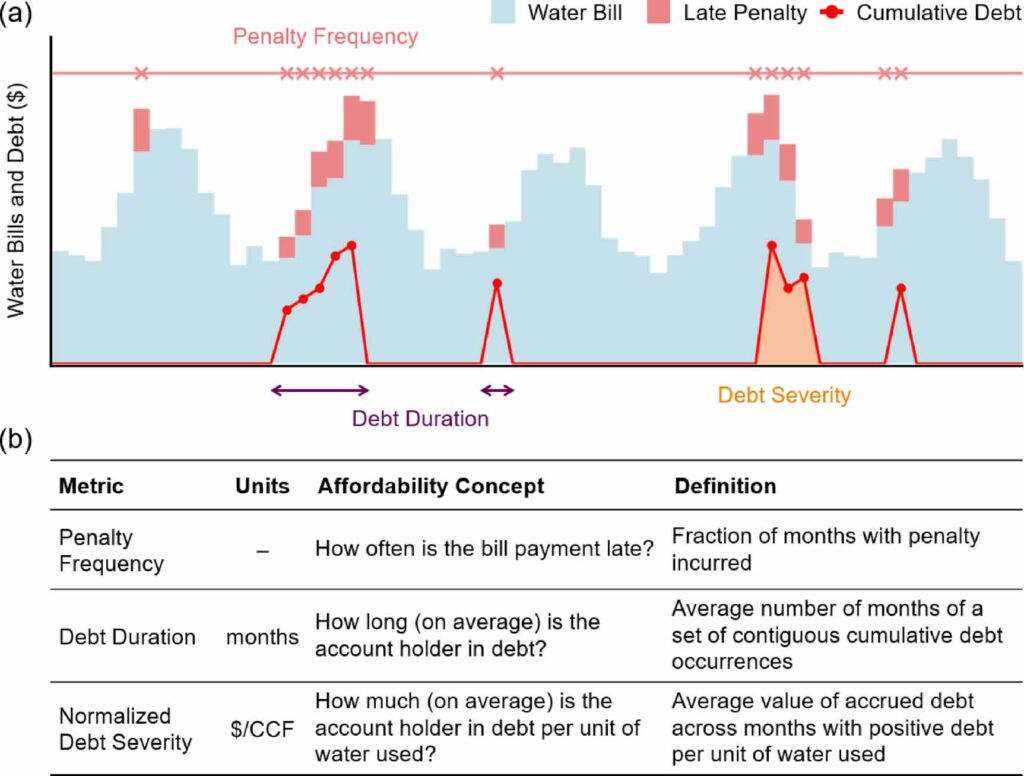
Source: Jennifer B Skerker et al 2024 Environmental Research Letters 19 074036
While her city hasn’t fully figured out how to address the need to provide clean water for all comers, Menard believes that Santa Cruz’s approach will be a harbinger of the future, an integral part of the new water management textbook. “[The department] has done some work in facing the fact we have an equity issue here,” she said. Helping low-income ratepayers “is not just in the interest of maintaining a good credit rating. It is a recognition that safe drinking water is a human right.”
“I ask myself, ‘How do we fund things that we consider to be important?’”
Rosemary Menard, former Santa Cruz water director
She added, “What has to happen – and not make water cost as much as mortgage — there has to be another source of funding beyond water rates….
“I ask myself, ‘How do we fund things that we consider to be important?’ We pass bond issues for hospitals or universities, we spread the cost to some statewide funding source and we get 50 percent of the costs in grants, not loans.”
Simply put, one solution is having regional, state and federal governments give grants to water agencies to pay for infrastructure repairs and climate adaptation. This may go against the grain for anyone thinking water management should remain a local concern. But this part of the water management textbook is already being rewritten.
Barton Thompson’s work, likely to influence that rewrite, is focused on the same issue. “What we really need,” he said, “is a program – probably at the state level, maybe at the federal level, certainly at a regional level – to pay for affordability programs in the water field. We have them in energy. We have it in the telecommunications area. We do not have it at the water level.”

Edited by Geoff McGhee.

Santa Cruz water utility grapples with a paradox: what to do when conservation becomes bad for business
Hemmed in by aging infrastructure, water scarcity and ratepayer resistance, utility managers seek to balance maintaining equitable service and remaining solvent.

Winter storms exposed the unfairness of California’s flood protections. Are marginalized areas closing the gap?
Floods driven by winter storms are nothing new in Monterey County, but the early March catastrophe that swelled the Pajaro and Salinas rivers and drowned farmworker communities exposed the extreme inequality built into flood-control systems.

EV Charging Stations Multiply, But Are Often Out of Reach for Disadvantaged Populations
California will prohibit the sale of new gas-powered vehicles by 2035. But charging-station infrastructure takes time to develop. Already, some places are in danger of being left out, perpetuating historical disparities. Can supporters of a green future avoid the mistakes of the past?

The Winners, the Losers, and the Landscape That Might Emerge If the Klamath River Dams Disappear
Taking down four dams in Oregon and California would be a coup for advocates of dam removal. It could also mark the moment when their movement rediscovers a more realistic goal: bringing restoration into balance with human needs.

By Land or Sky, Rural Western Communities Seek an Elusive Good: Broadband Internet Access
Two decades into the 21st Century, broadband internet access still falls short of reaching tens of millions of Americans — especially in hilly and remote parts of the rural West. But local initiatives and creative uses of technology are slowly helping close the divide.

U.S. Route 50 Was the Best Way to the Pacific; Now, It’s a Road to the Past
In 1919, a difficult cross-country trek made the case for better roads in the West. The roads came, but a hundred years later, Central Nevada may be as isolated as ever.























2 replies on “Santa Cruz water utility grapples with a paradox: what to do when conservation becomes bad for business”
It’s fascinating how Santa Cruz’s water utility is facing the consequences of successful conservation. It highlights a paradox we need to address West-wide: how do we ensure water utilities remain financially stable while simultaneously promoting and rewarding water conservation?
Felicity Barringer’s piece really emphasizes the need for new economic models in the water sector. Perhaps tiered pricing structures could be refined, or incentive programs developed to encourage businesses and residents to invest in long-term water efficiency upgrades even if overall demand declines. Exploring grants or alternative funding mechanisms that decouple utility revenue from water consumption might also be worth investigating. It prompts an important discussion about prioritizing long-term resilience and water security over conventional business models. Thought-provoking article!
Samantha: Thanks for a comment that reflects the imperative that water utilities’ economic model will have to change, sooner or later. Felicity