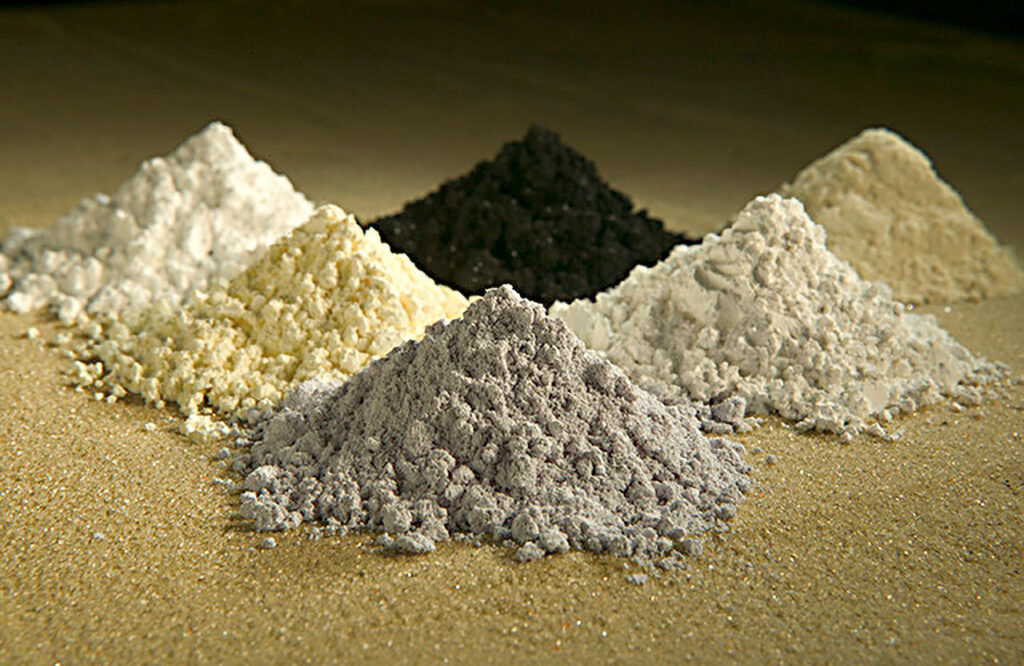
Earthworks The Mountain Pass mine in San Bernardino County has one of the highest-grade rare earth deposits in the world, with about seven to nine percent total concentrations of rare-earth elements. A defunct gold mine nearby may join it as the only one operating in North America. Erik Olsen
In the global race to secure hard-to-find minerals that help power everything from smartphones to wind turbines, California’s Mojave desert is emerging as an unlikely front line. The Colosseum mine, an abandoned gold pit, is now seen as a potential source of the rare earth elements underpinning the country’s clean energy development and technological leadership ambitions.
Once part of the first mining rush, the site’s revival for rare earth extraction epitomizes the current era, whose emphasis on copper, nickel, lithium, and rare-earth elements reflects demand created by the growth of electronics, the explosion of data centers, and green energy. Colosseum may have a new life. If, that is, the federal government continues to authorize an intensive and environmentally destructive operation in a protected area, the Mojave National Preserve.
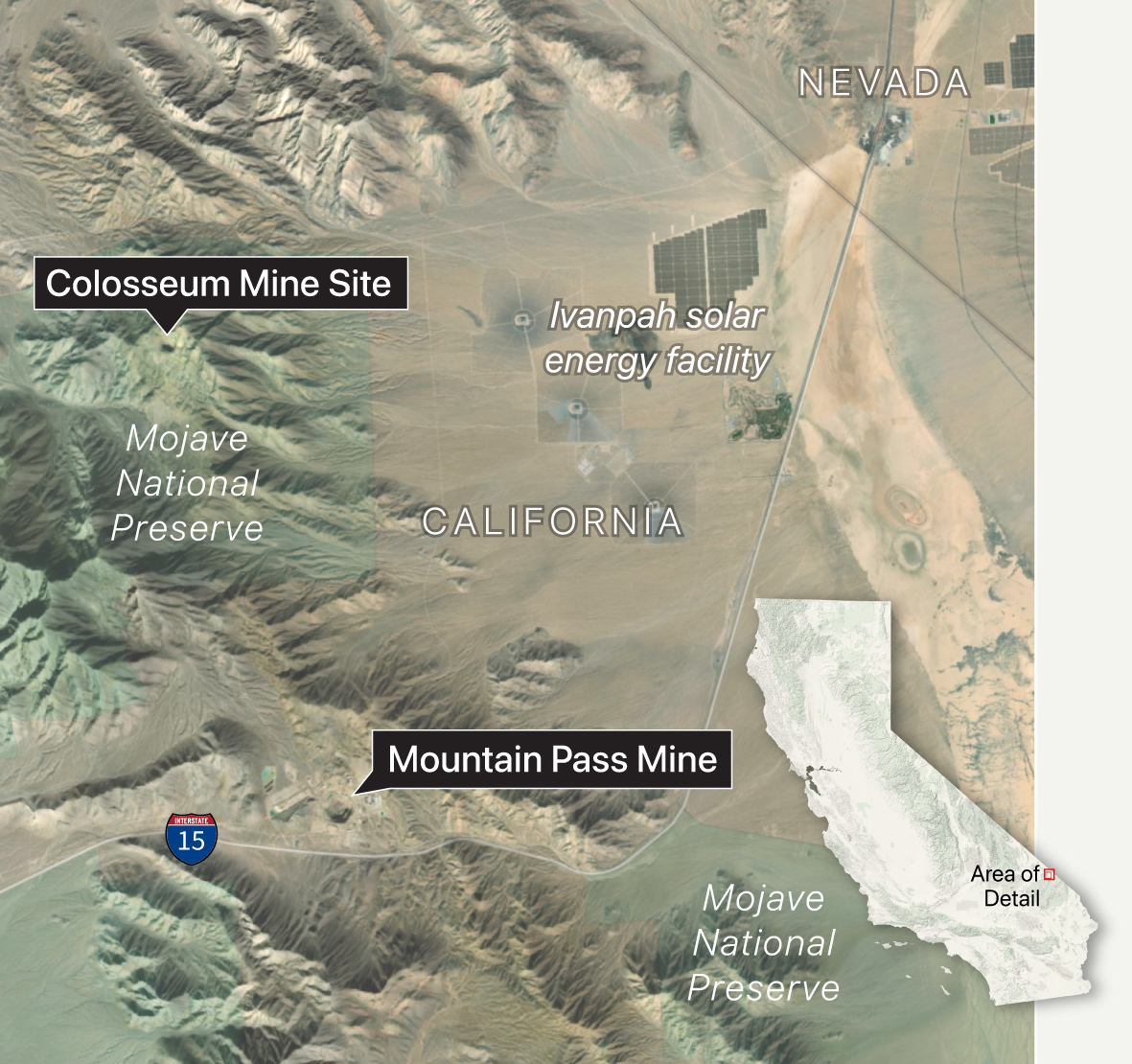
An Australian mining company called Dateline Resources, which specializes in North American mineral extraction, is leading the effort to restart Colosseum. In April, the federal Bureau of Land Management approved the work. The BLM’s April decision prompted opposition from Sen. Adam Schiff, a Democrat, and three Democratic congressional colleagues, There are more objections, though no legal action to date, from the National Parks Conservation Association. It argues that the National Park Service, another Interior Department agency, had taken responsibility for the land from the BLM when Congress established the preserve in 1994.
Dateline is working to show its proposed mining effort targets rare earth elements that are economically recoverable. If it does, Colosseum would become the second-ever rare earth element (REE) project in the United States. It is six miles away from the first – the Mountain Pass Mine, which is operated by the publicly traded Las Vegas company MP Materials. Among the shareholders, though by no means the largest, was a Chinese company, Shenghe, with about a seven percent stake. In July, the Defense Department took a 15 percent stake. More recently the Chinese firm has sold some of its holdings. (correction appended)
Even if both mines produced and refined significant quantities of ore, their output would be a tiny fraction of China’s rare-earths juggernaut. Still, they would guarantee a domestic supply, however small. The U.S. move to invest more in MP Materials than the Chinese firm demonstrates the active international competition for access to the components essential to powering a swatch of different technologies.
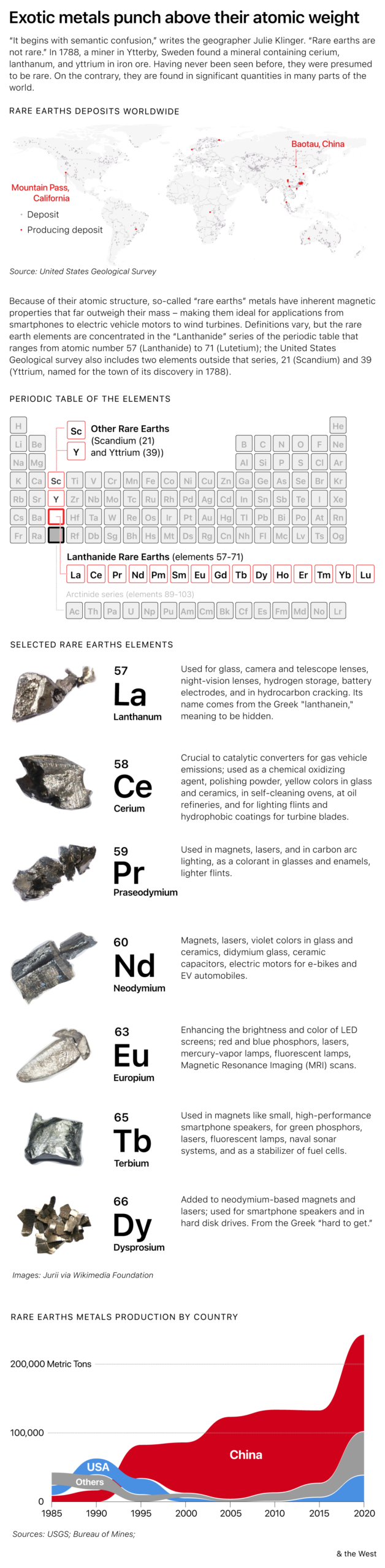
Magnetic, luminescent, and catalytic: rare earth metals’ properties are critical to technology
These “rare” elements are omnipresent in the signature technologies of modern life: smartphones, lithium-ion batteries, EV and e-bike motors and LEDs. But what exactly are they? A short answer: 17 metals typically found clustered together in mined ores. Their shared chemical structure and the unusual alignment of their outer electrons gives the minerals unique magnetic, luminescent, and catalytic abilities.
“They provide essential properties to many modern engineered materials, but they, in most cases, represent a very small weight percent of the product itself, and a relatively small part of the value of the product as well,” said Rod Eggert, a professor at the Colorado School of Mines.
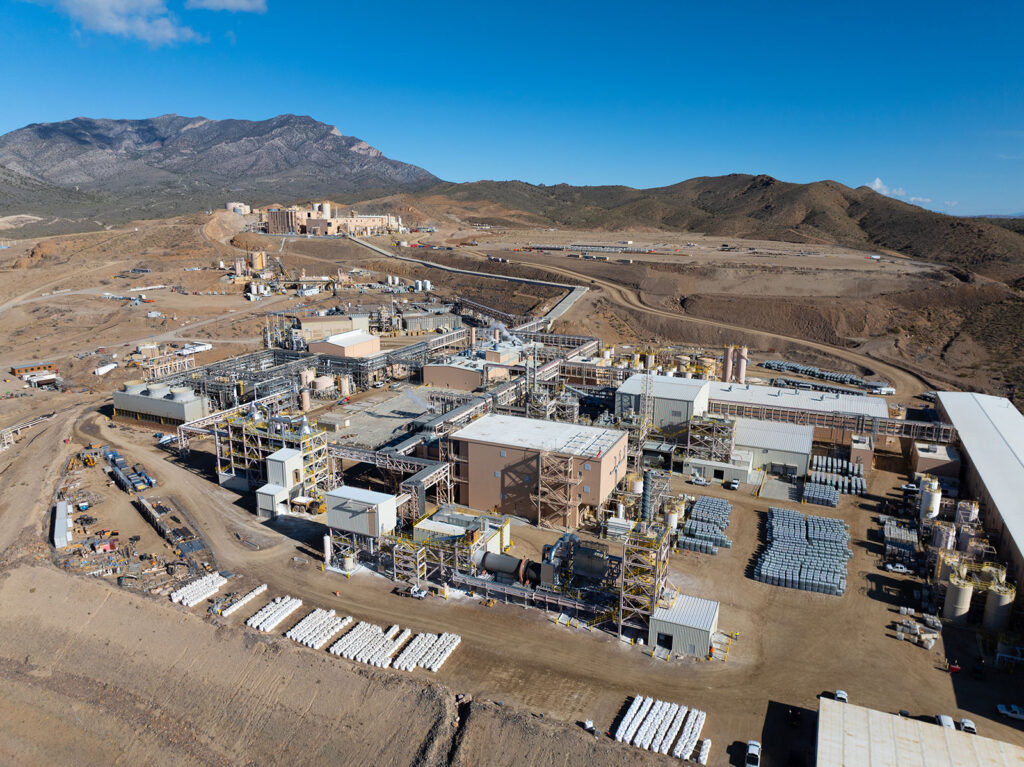
Finding concentrated, economically profitable deposits is challenging, hence their “rare” status. The operating Mountain Pass mine in San Bernardino County has one of the highest-grade rare earth deposits in the world, with about seven to nine percent total concentrations of rare-earth elements. The elements neodymium, praseodymium, dysprosium, and terbium are particularly valuable due to their powerful magnetic properties and ability to operate at high temperatures, which make them essential for everything from electric cars to solar panels to fighter jets and missile guidance systems.
The operating Mountain Pass mine in San Bernardino County has one of the highest-grade rare earth deposits in the world.
Erik Olsen
While the Colosseum project is still in its exploration phase, Dateline Resources is seeking these four crucial metals. Given its proximity to the Mountain Pass mine, which already has one of the highest-grade rare-earth deposits in the world, Colosseum’s prospects are promising. “You need to find a place where there are ingredients, and you preferably want to have better ingredients, like higher quality ingredients, or at least a lot of ingredients,” explains Sulgiye Park, a geologist and scientific researcher at Stanford’s Center for International Security and Cooperation.
She added that logistical issues are important in selecting a mine site. “If you have a mine somewhere, like in the rural area that does not have roads or infrastructure, that creates a big barrier for mining companies to go in, because you need to be bringing water sources and you need power supply, you need road in order to bring stuff in and out. So, Colosseum actually has a big advantage in that the infrastructure is already there.”
Breaking ground in a National Preserve, not just a mine but a refining center
From exploration to excavation, there are significant environmental concerns that come with unearthing these crucial magnets. Open-pit mining requires tens of thousands of tons of waste rock to be drilled for every ton of mineral ore extracted, a significant concern for a national preserve. In 2022, the National Park Service objected to Dateline’s explorations at Colosseum. This opposition continued through the end of the Biden Administration.The Park Service operates the Mojave National Preserve, where Colosseum is located. The Clark Mountains around it are home to some of California’s most biodiverse deserts. As a federally protected national park, the area is primarily used for nature preservation and recreation – uses incompatible with mining.
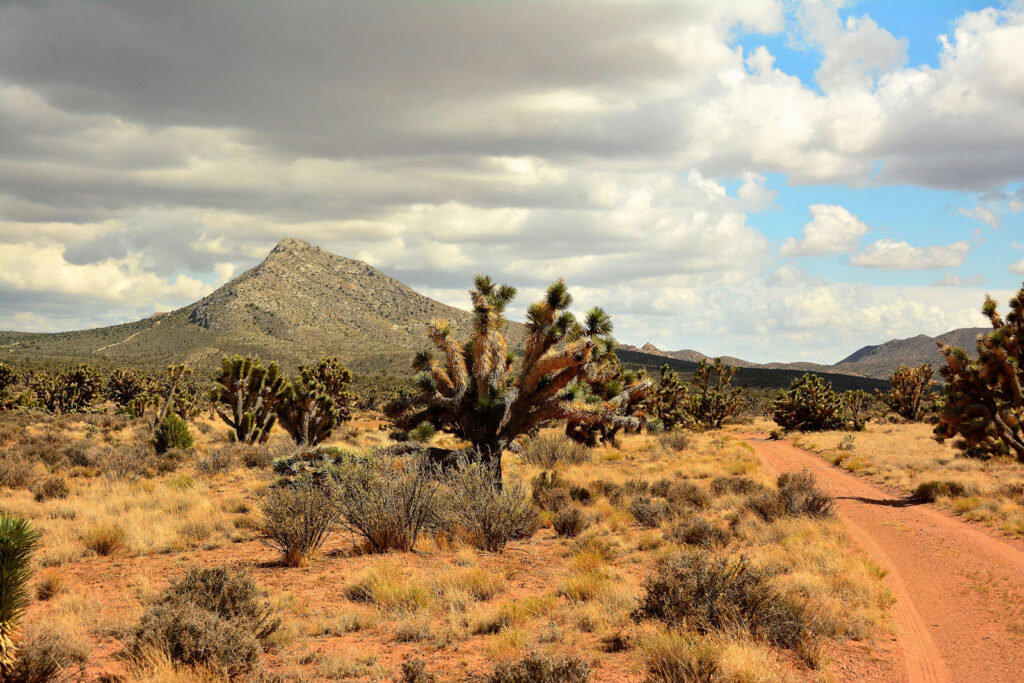
The preserve was originally created as part of the 1994 California Desert Protection Act to conserve the unique geological features of the area, including sand dunes, volcanic cinder cones, and lava tubes, along with the native flora and fauna such as Joshua trees, sagebrush, bighorn sheep, and mountain lions. These species and landscapes have coevolved for centuries to create a rich, biodiverse ecosystem - one that cannot be easily replicated.
But then President Trump took office. “Prior to the Trump administration coming in, the National Park Service had really created a lot of barriers for Colosseum mine, but that is within their jurisdiction, and it was in order to protect the preserve which is a federally-protected designation,” explained Chance Wilcox of the National Parks Conservation Association. He added, “The National Park Service has a duty and an authorization to protect these landscapes from development. What they were asking of the mine was to submit a new plan of operation.”
The bottom line: “There was a standstill under the Biden administration where the mines couldn’t really move any further, because the National Park Service had given them a cease and desist on any and all activities.”
In 2025, a sudden permitting shift for Colosseum
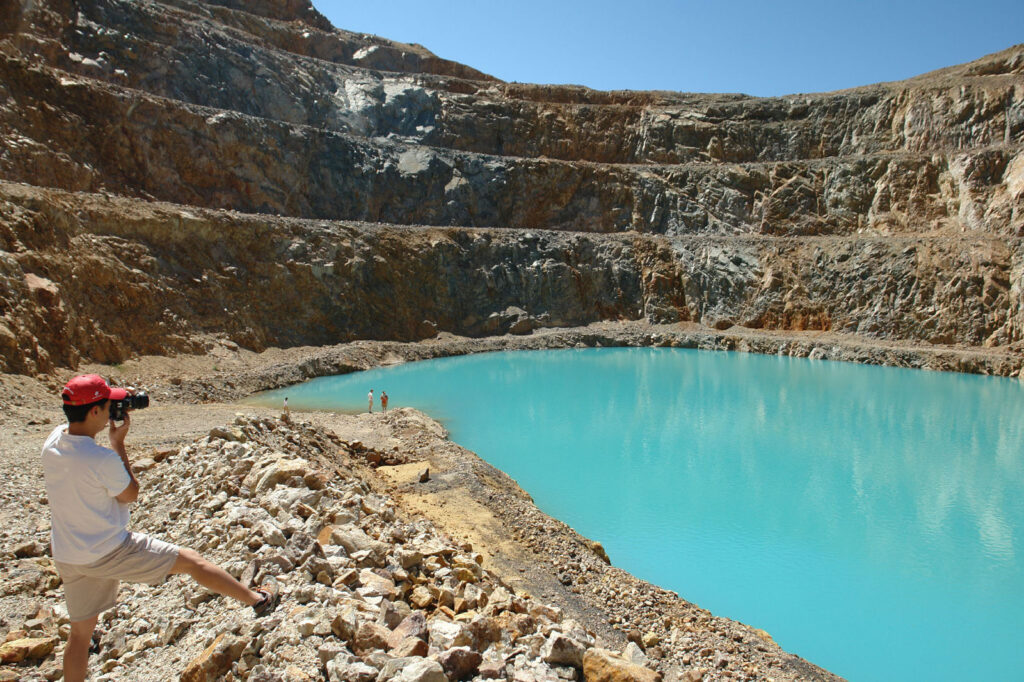
The Colosseum mine, an abandoned gold pit, is now seen as a potential source of the rare earth elements underpinning the country’s clean energy development and technological leadership ambitions.
Those objections were abandoned when the Trump administration came into office. With a sudden shift in national strategy emphasizing energy dominance and domestic supply chains, Dateline Resources was able to bypass standard permitting procedures and purchase the site using an older operational permit. It didn’t matter that the permit was meant for gold mining and had expired in 1985.
“This is a very unprecedented and very ridiculous kind of experience, because we’ve never really seen this where an act like the California Desert Protection Act, which was an act of Congress, kind of changes the designation of a land,” Wilcox said. But there was a catch. “The agreement was originally that through the passing of the … act, the mine would go dormant. But because of the reclamation status of the sulfates in the water, [the mine] was still being monitored ….” Ironically, lingering damages paved the way for Dateline’s purchase. With new federal support, they skipped the traditional paperwork required to initiate mining operations.
The fight over Colosseum reveals how the promise of a greener future is deeply entangled with the harsh environmental realities of resource extraction, whether the resource is rare earth elements, copper, or lithium. The mine’s likely revival is a reminder that all materials come at a cost.
“In the U.S., I think mining only accounts for maybe one percent of the GDP,” explained Terry McNulty, president of T. P. McNulty and Associates, Inc., a mining and mineral consulting company. This low number is primarily due to environmental regulations that prevented mining expansion, especially in areas like the Mojave.
“Mountain Pass was first closed around 2000 because of groundwater contamination. It remains a consideration in the Mojave Desert - we worry about Joshua trees, desert tortoises, you know, so just getting an archeological survey and a baseline environmental assessment is expensive, and very time consuming,” McNulty added. Dateline didn’t have to do one due to the existing infrastructure.
Schiff and the Democratic legislators who objected to the BLM’s approval of Dateline Resource’s efforts want a thorough assessment of the impact and want Interior to give the legal rationale for their decision to permit the activity.
In a fragile ecosystem, a complex process poses hazards at every step
Each step of the refinery process is associated with environmental hazards, from the energy required to crush and grind rocks to the water needed to separate chemicals with filtration, to the chemical runoff from solvent extraction. The process of separating out and refining individual rare earths can be toxic.
Since REEs come in relatively small deposits, large amounts of rock must be extracted to make mining operations economically viable, threatening significant change in the desert landscape, Wilcox fears. He said, “mining activity would have immense impacts on all … these pieces of the ecosystem … As mining traffic of heavy machinery increases through the area,” it has an impact on groundwater and wildlife. Each truckload of ore, Wilcox fears, compounds the risk of roadkill for the desert tortoise, a keystone species whose numbers have already plummeted from roughly 30 individuals per kilometer in past decades to fewer than four today. In addition, the mine’s dewatering and tailings could further strain an ecosystem dependent on scarce groundwater.
According to Wilcox, “the mine itself is inside of a section of the Mojave National Preserve in the Clark mountains… one of only three places in California where you can find white fir trees, and it comes with an immense amount of endemic species of plants such as Clark agave, Joshua trees… It’s also a bighorn sheep habitat, and the access road that goes to the mine is through desert tortoise habitat as well.”
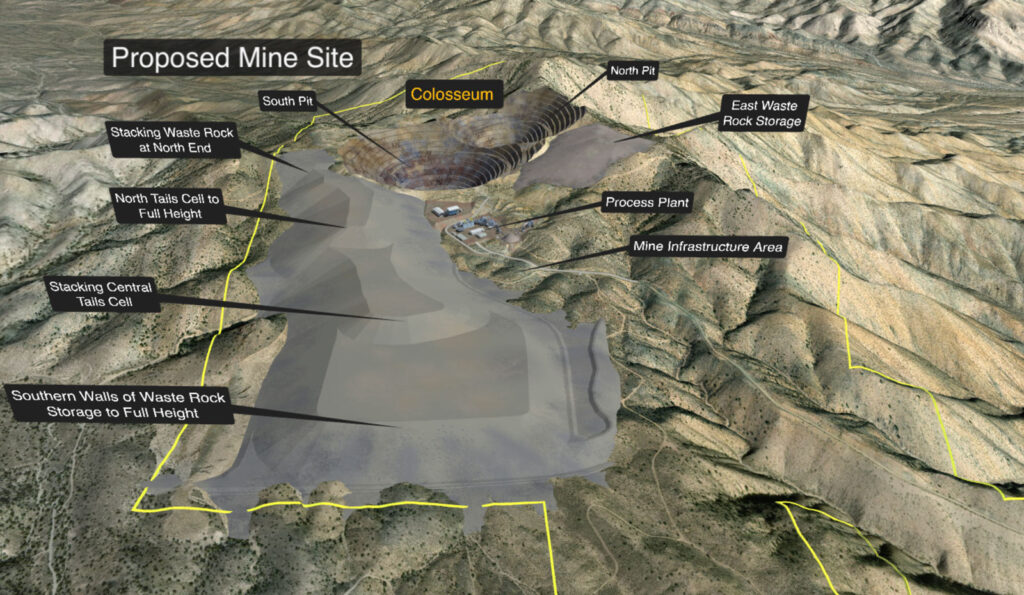
Even greater environmental challenges come after the deposits are mined. The elements are typically discovered in clusters, and separating them into individual minerals requires intensive processing and refinement. The solvent extraction and chemical filtration required are recipes for producing acidic tailings, radioactive byproducts, and toxic refuse.
“Imagine one big pile over all the rare earths mixed up together. The uses are for individual rare earths, or in some cases, pairs or sets of rare earths. And so one big pile of all the rare earths together is not terribly helpful,” Eggert, from the Colorado School of Mines, explained. “We need to separate the big pile into, you know, 12 or 13 individual smaller piles of …what’s called separated rare earth. And then a separated rare earth needs to be converted to a metal and to an alloy before it can be used in manufacturing.”
Each step of the refinery process is associated with environmental hazards, from the energy required to crush and grind rocks to the water needed to separate chemicals with filtration, to the chemical runoff from solvent extraction. The process of separating out and refining individual rare earths can be toxic. A common separation method involves placing the ore containing the 17 elements in a vat filled with a chemical solvent. The solvent can pull the various elements out of the rock and filter them into individual minerals.
“And within each of these separated streams,” Eggert added, “different customers have different quality requirements, different purity levels, and different impurities that are allowable or not. So it’s all the rare earth processing that is almost more of a specialty chemical industry than it is a mining industry.”
As the U.S. ramps up mining activity, will its chemical processing capabilities be able to keep up pace? Even if the four desired elements are successfully extracted from Colosseum, the question remains of where these elements will be transformed from ores into critical magnets for green technologies and defense applications.
A dominant China becomes a global bottleneck in rare earth processing
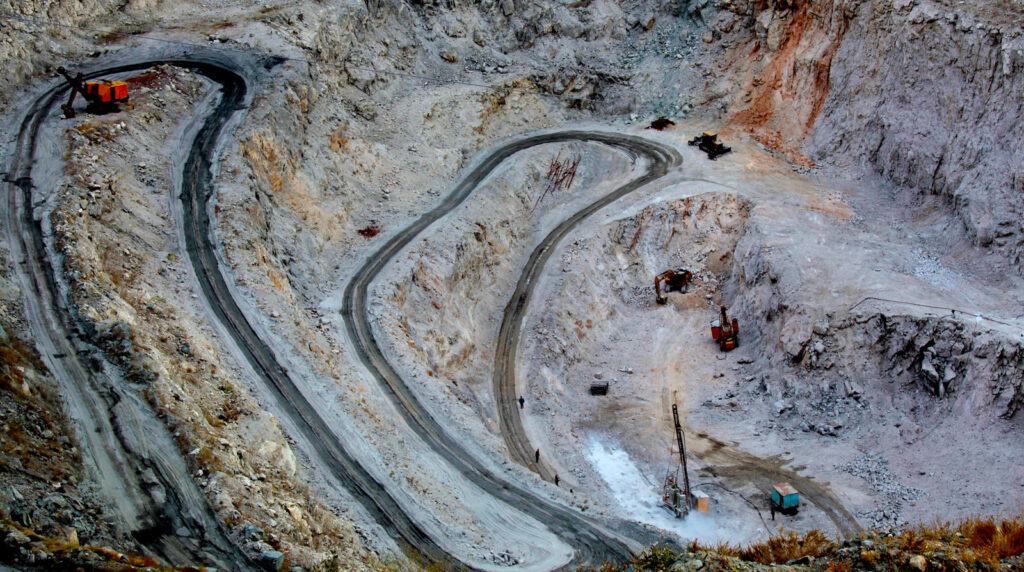
Today, China performs more than 90 percent of the world’s rare earth separation and processing operations. Even when ores are mined in other countries, they are typically shipped to China to be incorporated into end-use products.
The European Union and the United States had developed an infrastructure for rare earth processing as early as the 1920s. But many of these refineries were shut down in the 1980s, thanks to increased environmental health and safety regulations. “The wastes from these factories were sort of chemical nightmares with a lot of really toxic constituents in them, and the owners of these plants, both in Europe and the U.S., decided that they really shouldn’t do this anymore, that they should should treat the waste that they had created, shut down the plants and and get out of the rare earth business,” explained Terry McNulty, an independent mineral consultant.
“It was at about that point that a variety of entities in China decided to make that a core business, and over several decades became very expert in concentrating and then dissolving and then precipitating and finally separating rare earths and converting them into items of commerce,” he concluded.
A 2015 Boston University paper in “The Extractive Industries and Society,” covering the 150-year history of rare earth use, describes how China commandeered rare earth production. Today, China performs more than 90 percent of the world’s rare earth separation and processing operations. Even when ores are mined in other countries, they are typically shipped to China to be incorporated into end-use products. China’s ability to control global supply chains for crucial energy, defense, and intelligence technologies gives the country significant geopolitical leverage.
Of all countries that use rare earths, Japan has been most successful in creating an independent supply chain. Ever since a 2010 dispute led China to cut off its access to rare earths for two months, Japan has worked with an Australian company to set up a Malaysian processing plant, reducing its dependence on China, The New York Times reported.
“From an economic standpoint, China’s rare earth industry can be regarded as a cartel. It’s dominant enough to control global prices,” McNulty explained. “So a big risk for a non-Chinese entity is bringing a project online that’s financially justified for different rare earths, since those prices are very sensitive to global control by China, because their [China’s] costs are really quite low. It’s a risky business.”
Permitting and environmental regulations have long slowed expanded mining in the U.S. and disincentivized American companies from trying to compete. But the current administration’s interest in revitalizing onshore mining means key partnerships are being forged with the much larger Australian mining sector.
“Australia is a mining country,” McNulty said. “Mining is 20 percent of their GDP—it’s part of their DNA. They can raise capital easily for projects abroad, and Americans can’t.”
An international alliance forms around rare earths
“It makes a lot of sense for allies or like-minded countries to work together to establish supply chains that help diversify the world’s supply chains.”
Rod Eggert, Colorado School of Mines
The federal government is tapping into this existing infrastructure to build mineral relationships with Australia through a series of recent trade deals. Eggert noted that “there have been discussions of a portion of the mined material from the one Australian mine being shipped to the United States for further processing at a facility that would be cofunded between the Australian company and the U.S. government.” It is not yet clear where that facility would be.
“I don’t know what the prospect of that is, but certainly in principle, it makes a lot of sense for allies or like-minded countries to work together to establish supply chains that help diversify the world’s supply chains,” he added. “In my view, the goal for the United States should not be self sufficiency as much as diversification and diversification as a way to manage risk generally.”
Dateline Resources has leaned into this budding partnership between the U.S. and Australia to develop a business model focused solely on mineral exploration in North America. Their choice of Colosseum as a location could help create fully-fledged domestic supply chains within the U.S., since the nearby MP Materials owns one of the few vertically integrated magnet production chains in the country.
MP’s public-private partnership with the Department of Defense, its part owner, includes ongoing contracts and price guarantees for key REE products including the four key magnets that the Colosseum project targets.
For those envisioning a green energy transformation in the country, the benefits of domestic supply chains seem to outweigh concerns about environmental drawbacks. For those on the frontlines of the Colosseum project, this tradeoff is far less favorable. “I think that we all understand, even in the conservation world, … that mining is still necessary, right? We still need minerals for this society that we’ve created for the product that we need in our everyday lives, particularly for green technology,” Wilcox said.
“I do think that there is a way to go about it that is far more rooted in collaboration and regulations. Do I think that there should be a mine in a national park? Absolutely not.”
But if not a national park, where should the U.S. look to expand domestic rare earth extraction? Unfortunately for conservationists, mining sites are determined by what’s underground, not what’s above it - even if that is an ecological preserve. “Mineral deposits are where they’re found, and that location is governed by geologic processes,” said McNulty. “We have little choice. We can’t just go somewhere and say, ‘Well, I like to start a gold mine or a rare earth mine.’ ”
Correction
Due to an editing error, the article incorrectly stated that a Chinese firm once held the largest stake in MP Materials. Several other companies and individuals all had larger stakes than the Chinese firm.

Edited by Felicity Barringer.

Rare earths mining takes a heavy toll. Is it worth moving mountains for a domestic supply?
Widely distributed but hard to disentangle, exotic elements are vital to green energy and military applications. For decades, China has dominated the dirty business of mining and processing rare earth ores. Two Mojave desert mines, one operating and one planned, may change that picture.

A Central Valley family’s quest to revive a historic Black town is the work of generations
In its early 20th century heyday, Allensworth, California was celebrated as a model of Black self-sufficiency; then came loss and a long decline. A new generation is bringing new ideas, new money, and ambitions for a model economic and environmental rural community.

Thirsty for power and water, AI-crunching data centers sprout across the West
With promises of jobs and hopes for tax breaks, server farms are reshaping local grids, plumbing, and politics. Are they a boon for communities, or a burden?

Ketchikan calls itself ’Salmon Capital of the World.’ Does the title still fit?
Long since fish canneries built Southeast Alaska’s signature town, the trade is now being used to attract tourists.

Urban, rural and tribal: how three Wests diverge on cannabis
The West led the charge to legalize marijuana. As it becomes big business in many cities and towns, some others view it with distaste grounded in moral qualms or concerns about criminal cartels. Will growing revenues help sweeten the pot?

Idaho is increasingly a bullseye for Californian migrants
The state has gone from being an also-ran in the population sweepstakes to the country’s fastest-growing.