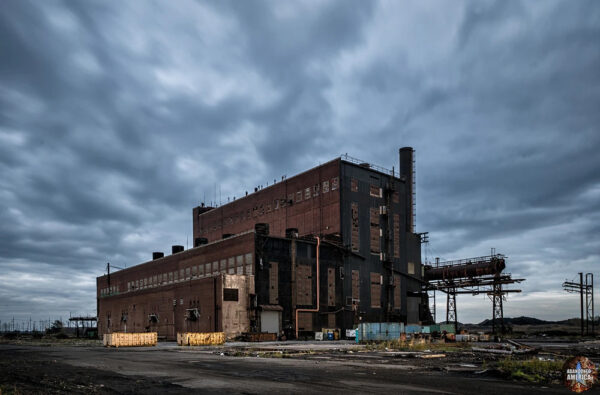
A fragment of coal’s heyday The former Penwood Power Station in Sparrow Point, Maryland burned coal to power a Bethlehem Steel facility nearby. Matthew Christopher/Abandoned America
Since last year, the federal Department of Energy has been on a quest: take the electrical grid back to the 20th century. Take it back to its 1980 self, before renewables. Old, broken or unreliable infrastructure? Keep it working – it can’t be abandoned. Regardless of alternatives and whatever the cost.
We explore the issues, personalities, and trends that people are talking about around the West.
The legal tools in use: executive orders, DoE emergency orders under the Federal Power Act and, since the Iran War, DoE emergency orders under the Defense Production Act.
The mid- to late-20th century was the heyday for fossil fuels, and in the West, 1980 was a banner year: In Craig, Colorado, Units 1 and 2 of the three units of a new coal-fired power plant had just come online, with just under 900 megawatts capacity. The Craig plant generated enough electricity to serve hundreds of thousands of average households.

In Washington State, the Centralia plant was operating at full capacity; two units generating 1,340 MW. During the 1990s, the Centralia plant was one of the largest in the Pacific Northwest and generated enough electricity in a typical year to meet the residential needs of roughly 800,000 households,
In northeastern Arizona, the Cholla Power plant was finishing an expansion to bring output to more than 1,000 MW.
At the time, Colorado, Washington, and Arizona were home to a big portion of the fleet of massive western coal plants located from Montana to the Southwest. Last year, Craig, Cholla and Centralia were among the few left; by the end of the year, all were retired or on the verge of retirement.
In 1980, coal supplied 52 percent of U.S. electricity. Last year it was 16.6 percent. The Trump Administration doesn’t want to see that percentage drop further. Three successive emergency orders from the federal government are keeping Craig Unit 1 and Centralia open as Utility Dive has reported. Cholla’s coal units remain shut; it plans to convert to a natural gas plant.

Fossil-fuel infrastructure and economics crumbled as alternatives appeared

Coal plants aren’t the only fossil-fuel constructions being reanimated. So are oil pipelines. In 1980, off the southern California coast, Exxon-Mobil was developing pumps and pipelines – called the Santa Ynez Unit – to produce and distribute millions of barrels of crude oil annually. As of 1981, the first section of the new unit produced about 30,000 barrels of crude oil from the ocean floor every day. To comply with environmental regulations, the oil was sent to a ship-based processing facility and thence 5,000 miles to a Texas refinery.
None of these facilities aged well. The Santa Barbara coast pipeline ruptured in 2015, causing one of the California coast’s worst oil spills, blackening 150 miles of beaches. It has been shut down since, until this year.

For coal plants like Craig and Centralia, stiff competition from cheaper natural gas, physical decay, spiraling costs, and changing environmental laws made it necessary to plan for shutdowns.
Until now.

The administration’s quest to bring back the energy infrastructure of the 20th century flies in the face of a new diversity of generation options – wind, solar, batteries – and the industry’s changed economics. A press release announcing the federal government’s December order to the Centralia coal plant’s owner read, “The Trump administration will continue taking action to keep America’s coal plants running so we can stop the price spikes and ensure we don’t lose critical generation sources.”
The closure decision had been sealed in a 2011 agreement between Centralia’s owner, the Canadian TransAlta Corporation, and the state of Washington. They had been at loggerheads for years over the air pollution emitted by the plant. Under the agreement, Centralia would be gradually shut down, the last unit closing at the end of 2025.
“Nobody wants to pay for this power. TransAlta doesn’t want to produce it.… Everybody has moved on.”
– Patti Goldman, Earthjustice
“Nobody wants this power,” said Patti Goldman, a senior attorney at Earthjustice, one of the environmental groups that is challenging the DoE stay-open order. “Nobody wants to pay for this power. TransAlta doesn’t want to produce it.… Everybody has moved on.”
The Energy Department’s legal filing countered by citing a recent report by the respected firm Energy & Environmental Economics, cautioning that “load growth and retirements mean the [Pacific Northwest] faces a power supply shortfall in 2026.” After years of national electrical demand staying flat, the U.S. Energy Information Administration reported it has recently jumped at least 2 percent annually; data centers are expected to increase demand significantly.
However, Earthjustice got in touch with the principal author of the E3 study who agreed the risk to the grid in 2026 was only “slightly elevated,” and that the hydropower capabilities prevailing this past winter were not taken into account. Given that, the author wrote, the order “need not be renewed in March 2026.” It was.
DoE’s rebuttal to the claim that an immediate crisis is required to declare a 202(c) emergency came in a legal case involving a Michigan plant: “The statute broadly defines what constitutes an “emergency” for purposes of this specific provision. It does not limit the Secretary to addressing ‘unexpected’ or ‘imminent’ circumstances.”
The government argued that, after decades when demand for electricity was stagnant, things have changed; demand is rising. “Reasons include expanding electrification of cars, trucks, and other transportation, the sudden proliferation of artificial-intelligence and other data centers, and a reshoring of domestic industry.” The recently released DoE Transmission Needs Study reported that significant expansion of the grid will be needed soon.
The government argued that, after decades when demand for electricity was stagnant, things have changed; demand is rising.
DoE’s language ordering the reinstatement of Unit 1 of Colorado’s Craig plant – which had generated 446 MW before it was closed – was similar to the Centralia order. “The reliable supply of power from the coal plant is essential for keeping the region’s electric grid stable,” the agency said in a press release. “The order prioritizes minimizing electricity costs for the American people and minimizing the risk and costs of blackouts.”
As for the administration’s argument in favor of the pipeline, Energy Secretary Chris Wright said in March: “Today’s order will strengthen America’s oil supply and restore a pipeline system vital to our national security and defense, ensuring that West Coast military installations have the reliable energy critical to military readiness.”
“For them, this is an emergency”

“We did not need the generation. We were shutting down for economic reasons as well as complying with federal and state laws.”
– Mark Stutz, Tri-State Generation and Transmission Association
Dave Owen, a law professor at the University of California College of Law, San Francisco, said that in the past, Section 202(c) emergency orders under the Federal Power Act were invoked to allow immediate, short-term responses to “things like the California energy crisis or major storms.” It was invoked about a dozen times since 2000, almost always for weather-related emergencies.
But none of the new emergency orders for plants from Pennsylvania to Washington involved extreme weather. All are based on assertions of possible future shortages. Owen’s take: “These are short emergency orders that emerge with no process. They didn’t see the need to make a case.” He then added caustically, “They could do it. They did it.”
The government’s legal arguments confirm Owen’s view. The defense it offered in an earlier case claims the Energy Secretary’s unilateral power. Opponents, the government declared, “cannot change the fact that actions taken in the Emergency Order fall squarely within the authority granted by [the law.].” No immediate crisis needed; the authority covers future risks: “Section 202(c) may be invoked to address a potential [energy] shortage.” I
“There is an element of nostalgic militarism in the Trump administration’s energy rhetoric. The administration’s emphasis on conflict and its proclivity for declaring emergencies seem calibrated to recall periods of national ambition in the face of crisis,” noted a recent Michigan Law Review essay co-authored by Alexandra Klass, a Michigan law professor, and Owen.
In an interview, Klass said, “They need to cite an emergency to exercise this authority. So it has to be an emergency. Once a coal plant shuts down it’s going to be shut down forever…. A big part” of the administration’s goal is “not to have coal plants shut down because they’ll be replaced by sources of energy they don’t like. … For them, this is an emergency.”
“They could do it. They did it.”
– Dave Owen, University of California College of Law, San Francisco
Mark Stutz, a spokesman for Tri-State Generation and Transmission Association, Inc., a co-owner of Colorado’s Craig plant, said in an interview, “For us there’s not an emergency. We were retiring the unit …. We did not need the generation. We were shutting down for economic reasons as well as complying with federal and state laws.”
In March, the states of Washington and Colorado and a group of environmental nonprofits challenged these actions in court. Some focus on the legitimacy of federal extension of its emergency authorities and others on the uncompensated costs imposed on utilities and their customers.
A dwindling coal supply chain
Except for the mighty Powder River Basin coal region in Wyoming, most U.S. coalbeds have seen considerable declines in production over the past two decades.

Pipelines’ owner was eager to reopen them – against California’s wishes

Unlike the coal plants’ owners, who have little appetite to stay open, the new owner of the two California pipelines had been pushing for permission to reopen them.
Unlike the coal plants’ owners, who have little appetite to stay open, the new owner of the two California pipelines had been pushing for permission to reopen them. In 2024, ExxonMobil sold its Santa Ynez unit to a Houston start-up, Sable Offshore Corp. As Berman Capital Group reported, to finance the purchase, Sable took a five-year, $643 million loan from ExxonMobil with a 10 percent annual interest rate.
A Cal Matters article describes how the Texas firm has been at odds with county and state regulators ever since about how much work is needed to ensure safe operations. It needs to sell oil and earn money to help service the loans. Local residents fear another spill. “We have such a beautiful place here on the coast. I don’t know why you would jeopardize it,” one told The New York Times.
The environmental restrictions imposed by Santa Barbara County, the state and the California Coastal Commission ceased to be an obstacle when, as PBS reported, Energy Secretary Chris Wright issued a new emergency order, this one under the Defense Production Act, To help the Iran war effort, the pipeline is needed to “address supply disruption risks caused by California policies that have left the region and U.S. military forces dependent on foreign oil.”
For Sable, that order amounted to a get-out-of-regulation-free card. The state filed a lawsuit to vacate the order, claiming an unconstitutional violation of state power to contain the environmental impact of industrial activity. But Sable’s owners believe a federal order makes state and local laws irrelevant. Cal Matters reported it “secured an extraordinary intervention from the Trump administration … to wrest oversight of the pipeline away from the California regulators who were blocking its path.”
Sable maintains that the Las Flores pipeline was thoroughly repaired and tested before the pumping began again in March. Its chief executive Jim Flores, has said, “we are providing American oil from American soil through an American pipeline to an American refinery for American consumers and the United States military.”

“We are providing American oil from American soil through an American pipeline to an American refinery for American consumers and the United States military.”
– Jim Flores, Sable Offshore Corp.
The state of California and various agencies launched a fusillade of lawsuits against the restart. A U.S. district court in May turned back one, the Department of Parks and Recreation’s claim that the restart would cause irreparable harm. Other actions are ongoing. In the 9th Circuit Court of Appeals, the state and the California Coastal Commission argued that the pipeline’s managers in 2024 ignored their orders forbidding its repair. In June, the appeals court upheld the Coastal Commission’s injunction against pipeline work done in 2024. But the legal developments seem out of sync with the reality that the pipeline is now operating.
Wright last month told Politico that the administration is considering creating a new strategic oil reserve in California, which Sable had proposed.
Recently, the legal fracas got more heated. Lawyers for the state and environmental groups argued before a panel of 9th Circuit judges that the pipeline was dangerously corroded and should be shut, Courthouse News reported. Then Politico Pro reported on a letter Sable sent last month urging federal authorities to use eminent domain authority and seize state and private lands on the pipeline’s route.
So far, that hasn’t happened. But even the earlier federal directive to override state law left legal experts nonplussed. Deborah Sivas, a Stanford law professor, told The Washington Post, “This broad expansion of the [Defense] act, where they’re saying we’re just going to preempt all of state law, we’re going to use it to just crush state law and order what we want going forward — it’s anxiety producing.”
In March California sued to vacate the order, decrying “this stunning usurpation of California’s police powers, and the powers of the state and federal courts” which it said “should be struck down swiftly and certainly.” But as the tug-of-war between state and federal authority continues, so does pumping: deliveries to Chevron have been going on for weeks; the platform can produce 50,000 barrels of oil daily.
Federal interventions jam normal coal-plant retirement processes, at a cost

TransAlta, based in Calgary, Canada, has said it would need an additional $23 million to maintain the unit’s ability to restart the process of burning coal.
Restarting oil and coal infrastructure isn’t cheap. The closure of Centralia’s last unit stemmed from a 15-year-old agreement with the Washington state legislature; Centralia was set for conversion to a natural-gas plant, a plan which was announced just a week before the DoE order and is now on hold.
In May, TransAlta, Centralia’s owner, sought the Federal Energy Regulatory Commission’s permission to recover $19.9 million – the cost of keeping the plant open – from customers like the Bonneville Power Authority, even though it produced no electricity. The two new orders will cost $8.3 million each, it said. TransAlta, based in Calgary, Canada, has said it would need an additional $23 million to maintain the unit’s ability to restart the process of burning coal.
In their legal challenge to the stay-open order, Utility Dive reported, the owners of the Craig coal plant argued “The costs of compliance fall directly on their members and customers, who must now pay to respond to the DOE’s finding that utilities in the northwestern United States have ‘a shortage of electric energy’…The members and customers must pay those costs even though neither Tri-State nor Platte River are experiencing these shortages…”
Craig’s customers had already paid to replace the unit that can’t be shut down. Since the plant closure was timed to coincide with the shuttering of the played-out local coal mine that supplied it, costlier new coal supplies must be found from farther away.
If emergency orders hold, who pays for maintaining outdated equipment?

The bills for keeping Centralia, Craig and four other coal-fired plants ready to operate could be passed on to customers.
If federal and state regulators agree, the bills for keeping Centralia, Craig and four other coal-fired plants ready to operate could be passed on to customers. This, some of Craig’s owners argue, means the government undertook “both a physical taking and a regulatory taking” of property without fair compensation or due process.
Will Toor, the executive director of the Colorado Energy office, told Stateline “Rather than allowing the realities on the ground, the regulators, and the utilities to make rational decisions about how to meet energy needs, we have the Trump administration trying to do Soviet-style central planning to push an ideological agenda that will drive costs to customers.”
Who pays? Owen, the California law professor, believes that “Ultimately this will either come out of energy company profits or out of the pockets of everyday people and businesses.”
Klass, his co-author, added, “These are the first orders where the Energy Department is acting on its own initiative for the political purpose of keeping coal plants open and reviving the coal industry.” She added, “that’s why you see pushback from the states – this is very expensive.”
A countervailing view came from the lobbying organization Count on Coal, an organization supported by the National Mining Association, It argued that a Michigan plant, among the first affected by a stay-open order, earned almost $5 million more in electrical sales than it cost to operate the plant for five weeks in May and June. But the plant’s owner, in a quarterly earnings report, said the net cost of complying with the orders for the first 10 months was $180 million.
The Institute for Energy Economics and Financial Analysis in its own report last month found “Ratepayers face at least $300 million in extra costs because of a series of [DoE] orders to keep coal- and oil-fired power plants open.”
On June 4, President Trump announced a $350 million investment in new coal plants – none have been built in more than a decade – including $89 million to study building one in the Matanuska-Susitna Valley north of Anchorage, Alaska. The administration also will spend $75 million to underwrite a new coal export terminal in Oakland – a move the California legislature may move to block.
The coal plants’ stay-open orders have been issued or renewed three times; renewals will likely continue as long as the Trump administration wants, barring a court-ordered reversal.
“They’ve got a policy to prop up the dying coal industry so they are pulling out as many tools – unlawful or otherwise – as possible to help the coal industry that can’t compete in the market on fair terms,” said Michael Lenoff, a lawyer for Earthjustice, a group contesting the orders.

Edited by Geoff McGhee.
What’s the energy emergency? To an administration keen on fossil fuels, it may be the threat of alternatives
The Energy Department has repeatedly invoked emergency powers to stop the closure of coal plants around the U.S. and reopen oil pipelines in the West. As court challenges inch forward, utilities and energy companies are dusting off equipment that was headed for the scrap heap.

Atomic energy, out of a box? In the rural West, an experimental reactor technology inches closer to reality.
Backers say Small Modular Reactors promise safe, cheap, carbon-free energy. But as is common in nuclear power, the reality is more complicated. The small city of Kemmerer, Wyoming, is set to house the first U.S. commercial-scale SMR demonstration.
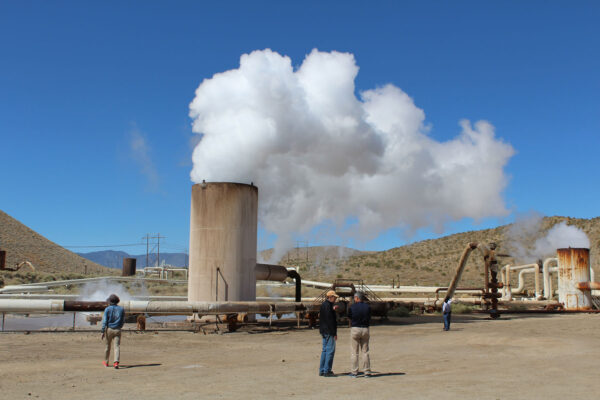
In the shadow of wind and solar, geothermal energy gets a fresh look
New technologies and spiking power demand are drawing attention to the Ring of Fire beneath us.
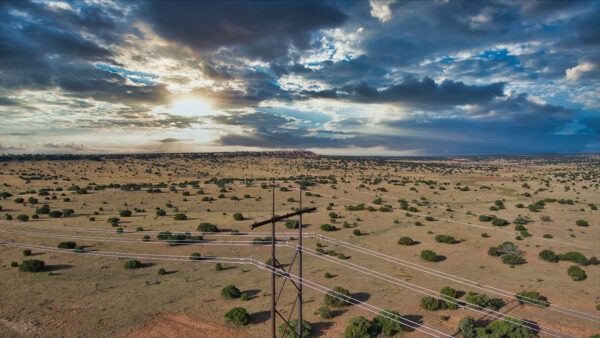
Transmission, transmission, transmission
What it takes to put renewable power on the West’s electrical grids.

’Despair and complacency are equally unwarranted:’ Q&A with Amory Lovins, energy visionary
Amory Lovins, a physicist who co-founded RMI (formerly called Rocky Mountain Institute), is a half-time adjunct professor of Civil and Environmental Engineering at Stanford and a visiting scholar at the Precourt Institute for Energy.

Weighing the consequences of losing carbon-free energy in California
Billions in potential federal dollars have led Gov. Gavin Newsom to pause the decommissioning of the Diablo Canyon nuclear plant — source of one sixth of the state’s green energy.