
Profit and peril An oil platform off the Pacific Coast, photographed in April 2010. Many drilling rigs off the Santa Barbara County coast have been shut down since a pipeline rupture in 2015. Bureau of Ocean Energy Management via Flickr
GAVIOTA, CA – In a move to increase oil revenues and avoid stranding an expensive investment, ExxonMobil is attempting to reopen three offshore oil drilling platforms off the coast of Santa Barbara County. The facilities stopped operating in 2015 when a pipeline rupture caused a major oil spill. Until a new pipeline becomes available, Exxon hopes to truck this oil to inland refineries.
This proposal could bring back profits for Exxon’s offshore facilities – when operational, their platforms had a valuation of nearly $1.2 billion. To resume operations, Santa Barbara County must approve its plan to transport crude oil to inland refineries using trucks. For the county, the restart would be a mixed blessing. It could provide hundreds of jobs and millions of dollars in taxes, lost when wells shut down. It could also increase the risk of serious pollution.
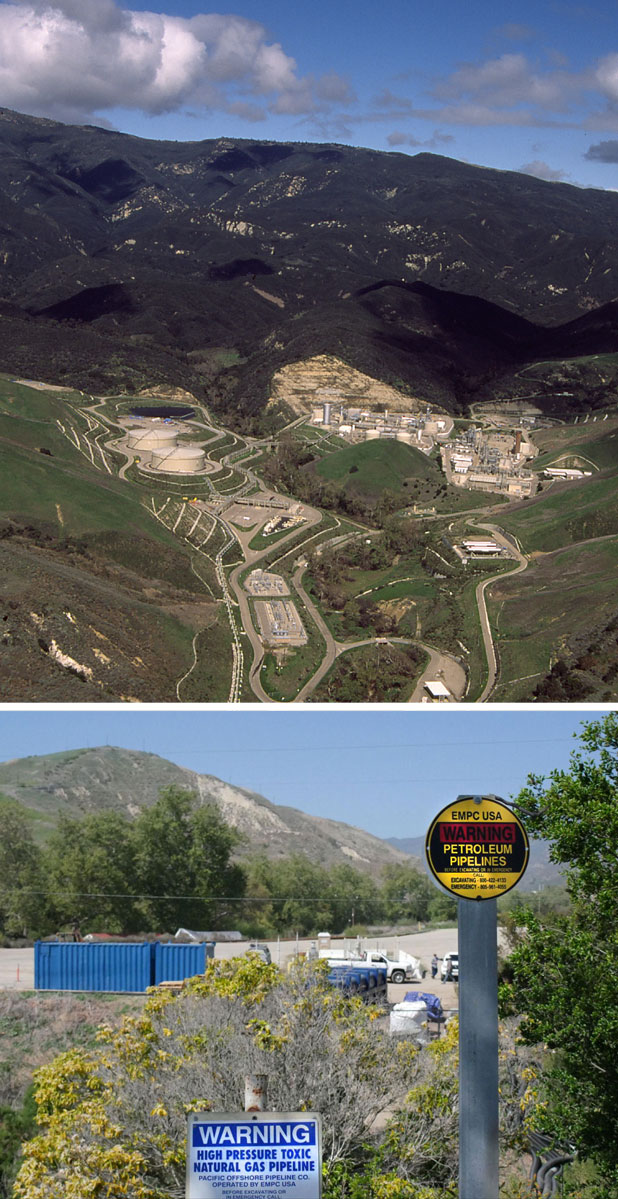
Top: The Las Flores Canyon Processing Facility, where crude oil collected from three offshore rigs was sent by pipeline to refineries; Below: Pipeline signage at the Las Flores facility. Bureau of Ocean Energy Management via Flickr, Benek Robertson
ExxonMobil’s Santa Ynez Unit (SYU) consists of three offshore platforms, and an onshore processing facility at Las Flores Canyon. A pipeline once transported oil from Las Flores Canyon to inland refineries. Then, a corroded pipe ruptured in 2015, releasing more than 140,000 gallons of oil into a biodiverse stretch of the Pacific coast. The spill coated coastal seas in oil, harming local ecosystems and shuttering local fisheries and beaches.
Since then, the Santa Ynez Unit has been unable to extract oil. ExxonMobil wants to resume operations, using trucks instead of a pipeline to move their product.
Exxon’s proposal has been supported by those who say the county can use the tax money it would generate, and opposed by environmentalists on three grounds: the increase in greenhouse-gas pollution from running the drilling machinery, the increase in greenhouse-gas pollution from the use of the oil itself, and the danger of oil spills if trucks carrying the product though a small windy road in the Cuyama Valley tip over, which has happened before.
County environmental impact reviews state that the project could have “significant, unavoidable impacts,” in the event of an oil spill from a tanker truck. A majority of local voters stand in opposition, and nearby refinery closures limit the oil’s possible destinations. The county is preparing its last environmental review, the final step before the proposal is evaluated by the planning commission. Multiple sources indicated that they expect this decision to be appealed to the county Board of Supervisors.
ExxonMobil says the restart would bring back local jobs and increase county tax revenues. After the shutdown, “a lot of people had to leave to stay with the company, and some people [were considered surplus] and laid off because there weren’t enough positions. The Federation really wants employees that left to be able to come back and continue to work here,” said Shannon Crudas, senior operator and former president of the S.Y.U. Employee Federation, a union, speaking in a video promoting the offshore facility’s restart.
The Santa Ynez Unit was once the largest taxpayer in the county, paying more than $4 million in taxes during their last year of operation. ExxonMobil says this represents critical funding for public schools, local law enforcement, and other public services. Many local chambers of commerce agree. Six chambers of commerce formed a coalition in support of the project and commissioned their own economic impact report about the job and tax benefits to the restart.

Platform Harmony, one of three rigs that comprise ExxonMobil’s Santa Ynez Unit. Bureau of Ocean Energy Management via Flickr
“It’s the wrong direction for our ocean, our coastal communities, and our climate. We need to be moving away from dirty fossil fuels, not restarting platforms that have been out there for decades,” said Linda Krop, chief counsel for the Environmental Defense Center. Multiple environmental organizations have opposed the proposal, citing concerns about climate change and spills that could affect both the Pacific coast and the state’s inland valleys. Hundreds of coastal businesses and thousands of West Coast fishermen have voiced opposition to the offshore oil industry.
Most of the oil refined and used in California doesn’t originate in the state. The supply of foreign oil to state refineries has grown steadily, while domestic oil supplies have decreased. In 2020, 47.5 percent of the oil refined in the state was imported, according to data from the California Energy Commission. While the state touts its electrification and decarbonization goals, its oil consumption remains high. “We have everything we need right here to help California meet its demands domestically, rather than import oil every day,” said Bob Poole, Director of Northwest Technical & Regulatory Affairs for the Western States Petroleum Association, speaking in a video promoting the offshore facility’s restart.
Oil extracted in California is primarily moved through pipelines, which normally operate continuously. But the pipeline that transported oil from Exxon’s offshore platforms to inland refineries has lain dormant since the 2015 rupture. A small fraction of the crude used at state refineries is brought in by rail or by truck. Existing studies have found that oil trucking has higher incident and fatality rates than rail, ship, or pipeline transport. Trucking does provide companies with greater flexibility, and is usually employed over short distances.
Roads Are More Dangerous Than Pipelines
Petroleum Accident Rate by Mode of Transport
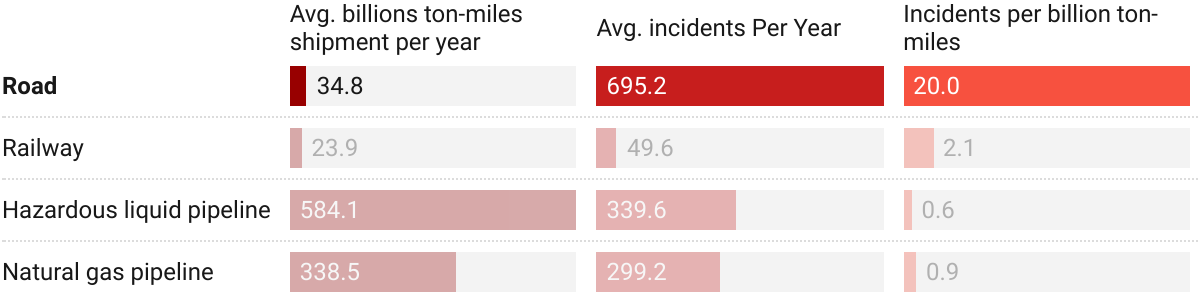
Source: Fraser Institute
Bill Lane Center for the American West
Plains All American Pipeline is still seeking to replace the ruptured pipeline. In the meantime, Exxon released an interim trucking plan showing the route the oil from offshore platforms would travel: from an onshore processing facility at Las Flores Canyon to either the Phillips 66 Santa Maria Refinery — whose closure has already been announced — or the Plains Pentland Terminal near Maricopa, CA.
County officials with the Santa Barbara County Planning Commission examined the trucking plan’s environmental impacts, and recommended that Exxon avoid sending trucks along Highway 166 through the Cuyama Valley.
A Hazardous Route for Tanker Trucks
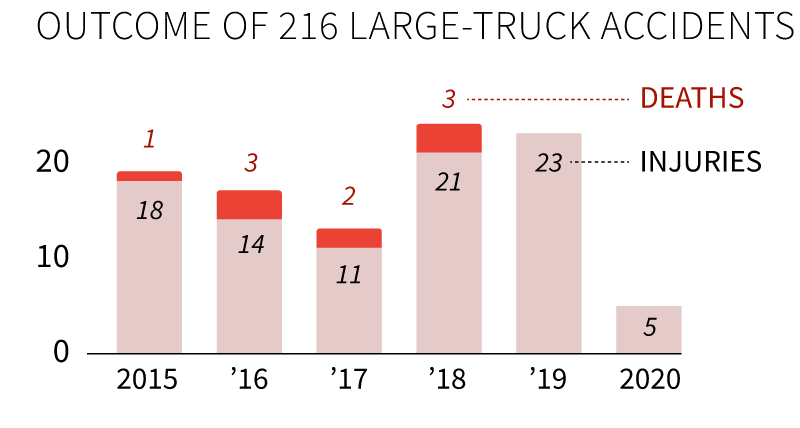
Since a pipeline rupture spilled 142,000 gallons of crude along the Santa Barbara coastline in 2015, ExxonMobil has sought to transport oil by truck to a refinery in Santa Maria and a pipeline entrance in the Central Valley. Its preferred route to the pipeline terminal uses state Highway 166, a hilly, twisty, two-lane road through the Cuyama Valley. Even without oil deliveries from offshore rigs, the route saw 216 large-truck accidents that led to 92 injuries and nine deaths. ExxonMobil has sought permission to send up to 70 tanker trucks per day down the route.
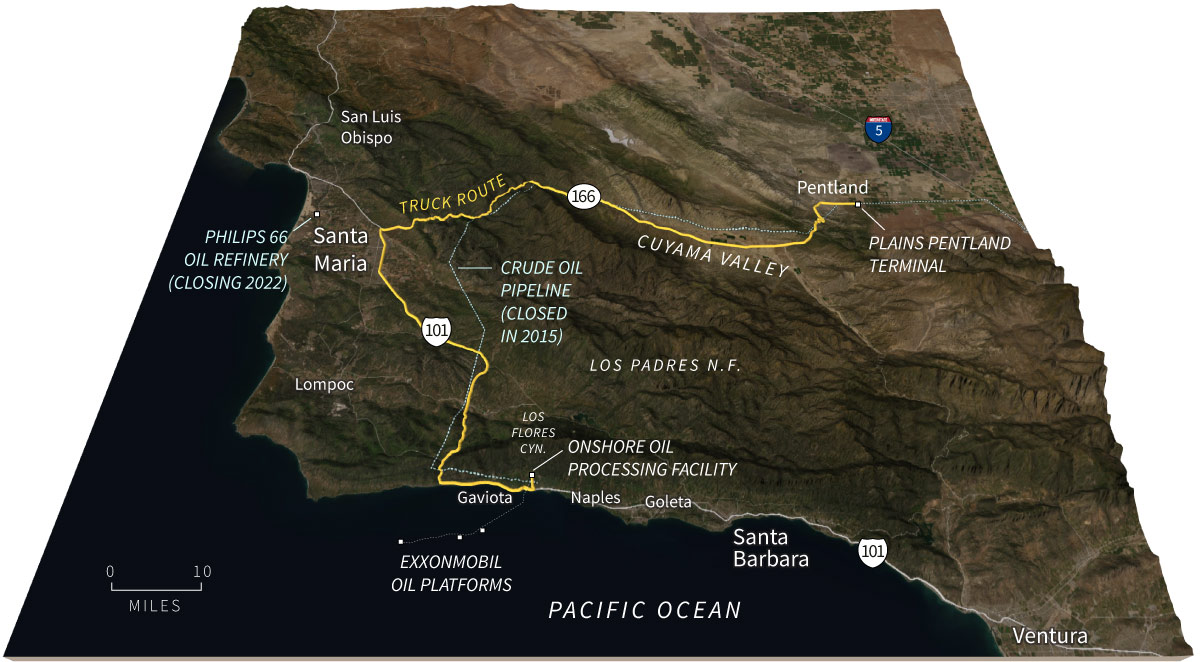
Sources: California Highway Patrol (crashes); BOEM (oil rigs); ESRI (Imagery and route planning); Natural Earth Data;
GEOFF McGHEE/BILL LANE CENTER FOR THE AMERICAN WEST
This routing option would send dozens of additional trucks along a winding, two-lane highway without turnouts. The road through the Cuyama Valley already struggles with trucking traffic, which causes slowdowns and increases the incidence of risky passing attempts. In the last five years, 216 trucking collisions caused 92 injuries and nine deaths along Exxon’s proposed route, according to California Highway Patrol data. “It’s one of the most dangerous roads in California,” said Lynn Carlisle, Executive Director of the Cuyama Valley Family Resource Center.
Oil trucking along this route has led to spills. In 2020, a 4,500-gallon spill from an oil truck polluted the local river and threatened to contaminate the nearby reservoir. “Two hundred thousand people depend on that groundwater basin for their drinking water and their farms,” said Ken Hough, the executive director of the Santa Barbara County Action Network.

A segment of the proposed Highway 166 route. BENEK ROBERTSON
The specter of more oil spills comes as Cuyama Valley faces a growing water crisis. Decades of agricultural overpumping of groundwater for irrigation has left the local aquifer critically overdrafted, with increasingly insufficient dilution of fertilizer nitrates and naturally occuring arsenic. “Eighty percent of people in Cuyama buy bottled water,” said Carlisle.
New Cuyama, a small community, is built around agriculture. As the town wrestles with water issues and trucking traffic, some here feel Exxon’s proposal could further exacerbate dangerous road conditions. “It’’ll have an enormous impact on that community with school buses going on that road, turning in and out all the time. It’s bad enough as it is,” said Carlisle.

An oil tanker truck stops to refuel near the junction of Highway 101 and Highway 166. BENEK ROBERTSON
Exxon has downplayed the impacts of their trucking plan on road congestion, saying only four to six trucks would be on the road at any given time. In 2016, the company safely moved 400,000 barrels of crude to Santa Maria – the company’s preferred destination for crude – using oil trucks.
County planners also sought to reduce trucking along Route 166, recommending that Exxon direct trucks to the closer refinery in Santa Maria. That recommendation hit a snag when Phillips 66, the operator of the refinery, announced its plans to close the facility at the end of 2022. This forced Exxon to temporarily withdraw its proposal; it is now being reevaluated by county planners. With this closure, Highway 166 and the Cuyama Valley become a crucial part of the proposed restart.
Exxon’s proposal carries significant climate-change implications, which led to criticism of the restart. As climate change drives major droughts, wildfires, and ocean heat waves across the Golden State, the idea of resuming carbon-intensive oil and gas extraction angers environmentalists. “The Santa Ynez Unit was the largest facility source of greenhouse gas emissions in Santa Barbara County,” said Katies Davis, group chair for the Santa Barbara Sierra Club.
Exxon argues that the restart would be a boon for local jobs; up to 435 permanent jobs could be created. It also touts tax revenue increases to help pay the county’s teachers, firefighters, and law enforcement officers. “One of the important things that the oil industry provides for Santa Barbara County is the revenue that they produce through our property taxes. That benefits all of us for what we receive through our public safety, for example,” said Michael Bennett, former Goleta City Councilman, speaking in a video promoting the restart of the Santa Ynez unit.
In their last full year of operation, the company paid more than $4 million in county taxes at the Santa Ynez Unit facilities. Even though property taxes from oil operations in Santa Barbara County make up just one percent of total property tax revenue, the loss of these revenues could impact funding for local school districts.
Local school districts receive differing amounts of oil revenue based on factors like their size and the oil-related properties within their district boundaries. For Vista Del Mar Union School District – a tiny district built entirely with funding from Chevron – oil and gas revenues made up 40 percent of their budget.
Larger local districts, like Goleta Union School District, have been significantly less affected by losing of S.Y.U. revenues; Oil revenue makes up just 1.5 percent of this district’s overall budget.
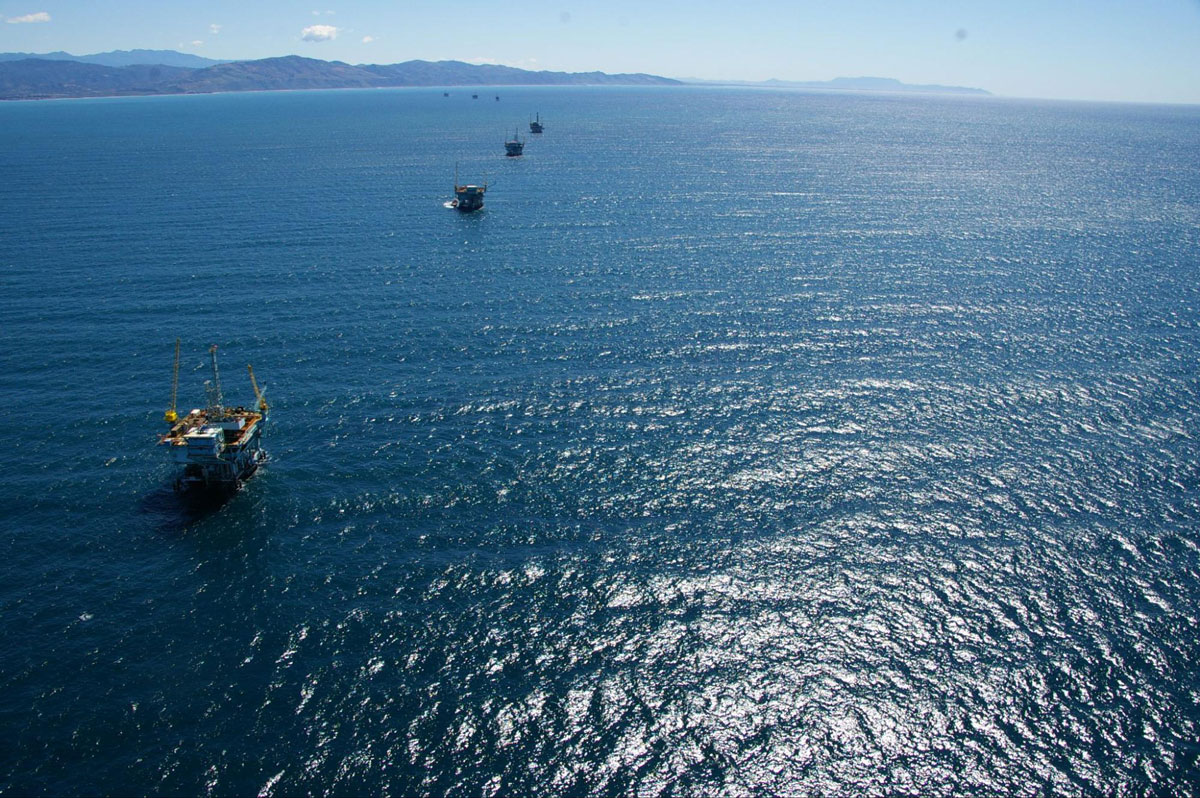
Offshore platforms in the Santa Barbara Channel. Bureau of Ocean Energy Management via Flickr
Tax revenue is important. So are tourist-industry revenues. Santa Barbara’s coastal economy depends on its picturesque beaches and biodiverse seas. Across the region, business support for an offshore drilling ban is growing. Hundreds of businesses and thousands of fishermen have joined the Business Alliance for Protecting the Pacific Coast, which supports a drilling ban.
California’s offshore oil industry has struggled in recent years. About half of the 27 platforms off Southern California have paused production, and many are slated for decommissioning. Venoco, once a major producer of oil in the Santa Barbara Channel, declared bankruptcy in 2017. When asked about the health of the Southern California oil industry, Errin Briggs, supervising planner for the County of Santa Barbara said, “They’re on life support.”
Facing increasing public opposition to coastal drilling, many Democratic policymakers seek to curtail it. Representative Salud Carbajal, who represents the area, has introduced theCalifornia Clean Coast Act. It would ban future offshore oil and gas leasing on the Outer Continental Shelf off California, a region that the Trump Administration had targeted for drilling.
President Biden has shifted federal policy on offshore drilling; In January, he issuedan executive order pausing new leases for oil and gas drilling in federal waters. The order also called for a rigorous review of existing leasing practices in federal waters.

The soon-to-be decommissioned oil Platform Holly lies two miles off the shore of Isla Vista in Santa Barbara County. Bureau of Ocean Energy Management via Flickr
Today, state and federal agencies are working to plug offshore wells and lay many of the region’s hulking platforms to rest.The task is difficult and expensive; though oil companies will bear most of the multi-billion dollar cost, significant cleanup funding will be covered by taxpayers. California’s state legislature has budgeted tens of millions of dollars to seal wells and remove aging oil infrastructure from the Pacific.
As Exxon pushes to restart the Santa Ynez Unit, Santa Barbara County is evaluating a replacement pipeline project. The fate of Exxon’s trucking proposal remains unclear; Briggs said he expects the decision to be appealed regardless of the outcome.

Edited by Felicity Barringer and Geoff McGhee.
Read Next in …& the West

What it May Take to Harness Solar Energy on Native Lands
The Navajo Nation has the most capacity, but its troubled energy history and culture of livestock grazing make solar development fraught.
Reader Comments
Submit your own thoughts and questions by using the form at the bottom of this page. Entries will be reviewed and posted as we get them.