Allensworth from above. Erik Olsen
ALLENSWORTH CA – A rural community in the southern reaches of the San Joaquin Valley is raising a singular question: can a community be created twice? Can a faded town retain such powerful resonance that it inspires a new generation to revivify it with the same propulsive vision that first brought it to life?

This arid, largely impoverished settlement of 500 or so – mostly Hispanic farmworkers – clings to the shore of a vanished lake. Beside it is a state park honoring the original town and its dynamic founder, Col. Allen Allensworth. In 1908, this Kentucky-born escaped slave, who had become a minister and high-ranking military officer, moving around the West with his infantry unit, joined four other Black professionals and bought land here. They created a self-sufficient, self-governing Black town in Tulare County.
The town grew fast as Blacks from Los Angeles and from military units around the country answered their appeal to join California’s first – and only – town founded, funded and run by Blacks. A token of the worlds they left is found planted in the uneven earth of the town’s neglected cemetery: headstones etched with the dates of residents likely born into servitude: 1856-1924, 1863-1932.

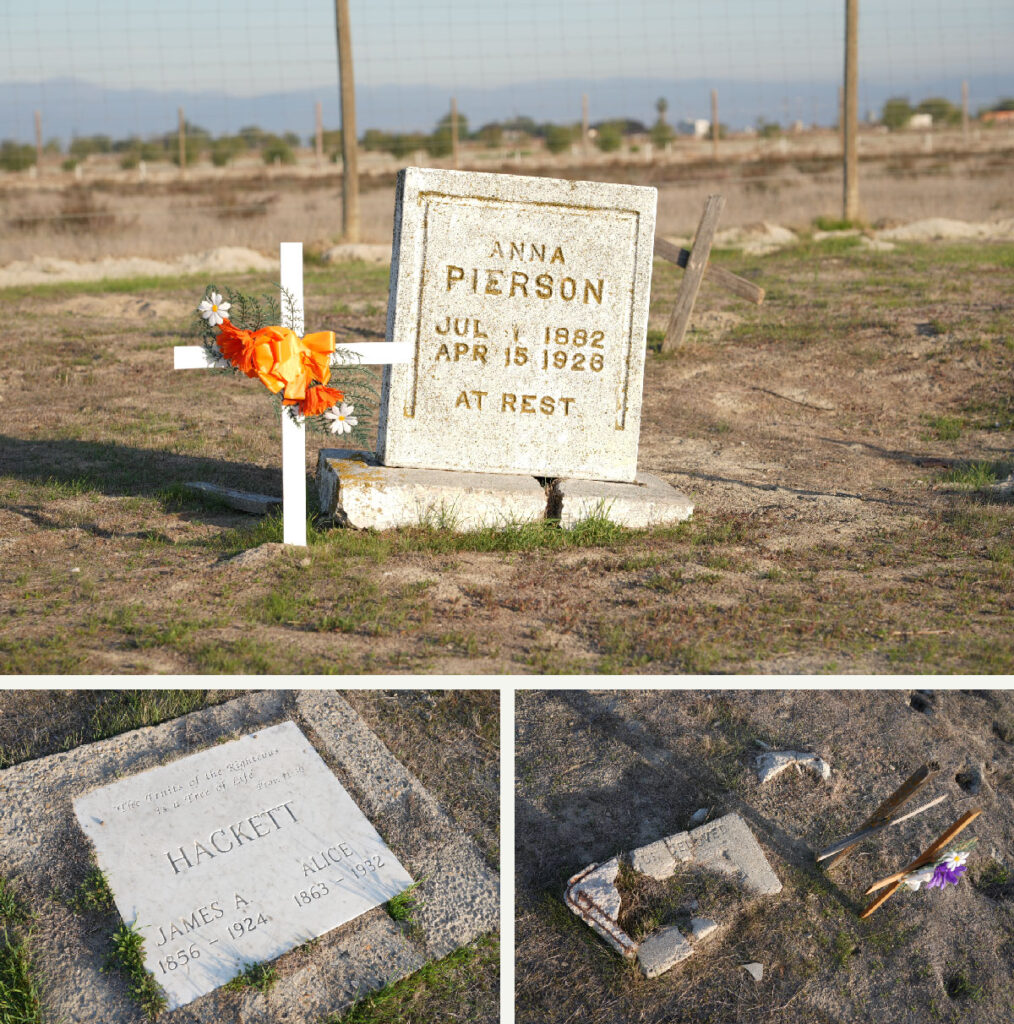
The cemetery has echoes of this one-of-a-kind community where former slaves took charge of their lives. The actual town withered in less than a generation, hollowing out as the Ku Klux Klan was expanding nearby. On the eve of World War I, Allensworth was systematically stripped of its economic support. In 1914 its railroad depot, essential for commerce, became irrelevant when the Santa Fe railroad built a spur line to a white town nearby. The firm that had contracted to make water deliveries for farmers reneged on its promise.
That same year Col. Allensworth was hit by a motorcycle and died; some still murmur that it wasn’t an accident. Nothing was proved. But no one could replace him. People left; the town spiralled into obscurity. Economic racism vitiated its founding era.
In 1908, a Kentucky-born escaped slave joined four other Black professionals and bought land here. They created a self-sufficient, self-governing Black town in Tulare County.
In 1908, a Kentucky-born escaped slave joined four other Black professionals and bought land here. They created a self-sufficient, self-governing Black town in Tulare County.
In 1908, a Kentucky-born escaped slave joined four other Black professionals and bought land here.
They created a self-sufficient, self-governing Black town in Tulare County.
California Colony and Home Promoting Association (bird’s-eye view); New York Public Library via Wikimedia Foundation (Allensworth portrait)
Two generations later, environmental racism threatened its future. But residents fought back. The late 20th century was the era of defense: successful work to kill projects that could have buried a proud past and strangled a vibrant future. Now an era of renewal is underway. In the 2020s, a new generation, running newly resilient community organizations, has raised millions of dollars. A re-energized community has arisen.
The town’s leaders envision an Allensworth whose rural residents obtain the elements of modern life that are now missing: drinkable water, a town-wide sewer system, a well-tended cemetery, an air-conditioned “resiliency center” with a small grocery store, health clinic, wifi, and postal facility. An Allensworth whose exhausted land transforms into healthy soil growing fruits and vegetables residents can use and sell.


Tekoah Kadara, a crucial link in the Allensworth Progressive Association, is an apostle of this vision, which is laid out in a 100-page community planning document sent to Tulare County. “I feel like all of it’s going to work,” he said, speaking in an accelerated cadence. “God, Allah, the Universe, whatever you call it, is linking us up to do something amazing in the heartland of California.” Allensworth “needs someone to care … [about] how to steward the land and how to steward each other.”
He sees the future of the town’s land and its people as two parts of the same equation. In a Fresno Bee article, his mother Denise Kadara, the APA’s president, wrote the town “is poised to be the organic farming hub of southwest Tulare County.”

Backers articulate a bold vision, while skeptics wonder
“Is poised to be?” What will it take to get there? And where will support come from? “They’re trying to make an oasis in a desert. How’s that going to happen?” asked one local official.
Carol Sotelo, a resident, believes the vision of the community plan will be reality. “Absolutely. It will happen.” Her husband, Efrain, added, “We want to see this happen. People are beginning to buy in. Once the wheels get in motion, there won’t be any stopping it.”

Kat Taylor, the head of the TomKat Educational Foundation, which has donated nearly $500,000 to the APA in the last two years, echoed Sotelo: “There are knowledgeable people who are very interested in Allensworth. There’s a real there there. It’s a very tiny community, but so catalytic. It would be so metaphorical if it rose out of the ashes again.”
“It’s a very tiny community, but so catalytic. It would be so metaphorical if it rose out of the ashes again.”
– Kat Taylor
History might counsel against such optimism. Allensworth is a thin polygon of fields dotted with 150 homes – trailers interspersed with small, neat homes and bedraggled shacks barely glued together or already abandoned. Their low-slung profiles barely interrupt the relentlessly flat landscape. They hug ramshackle roads amidst fields of cotton, alfalfa, pistachios and oranges. Most residents are Latino immigrants.
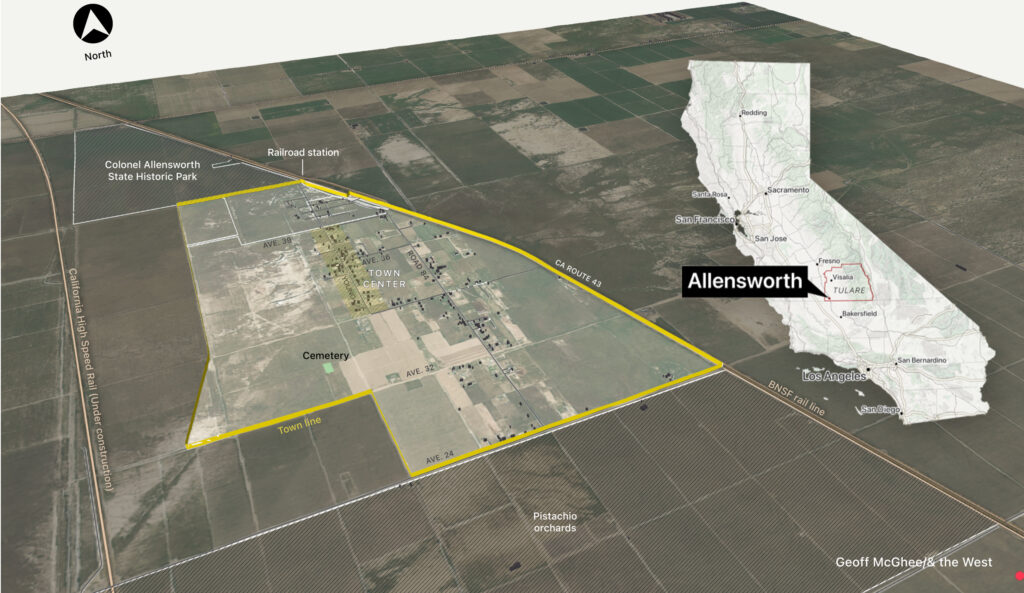
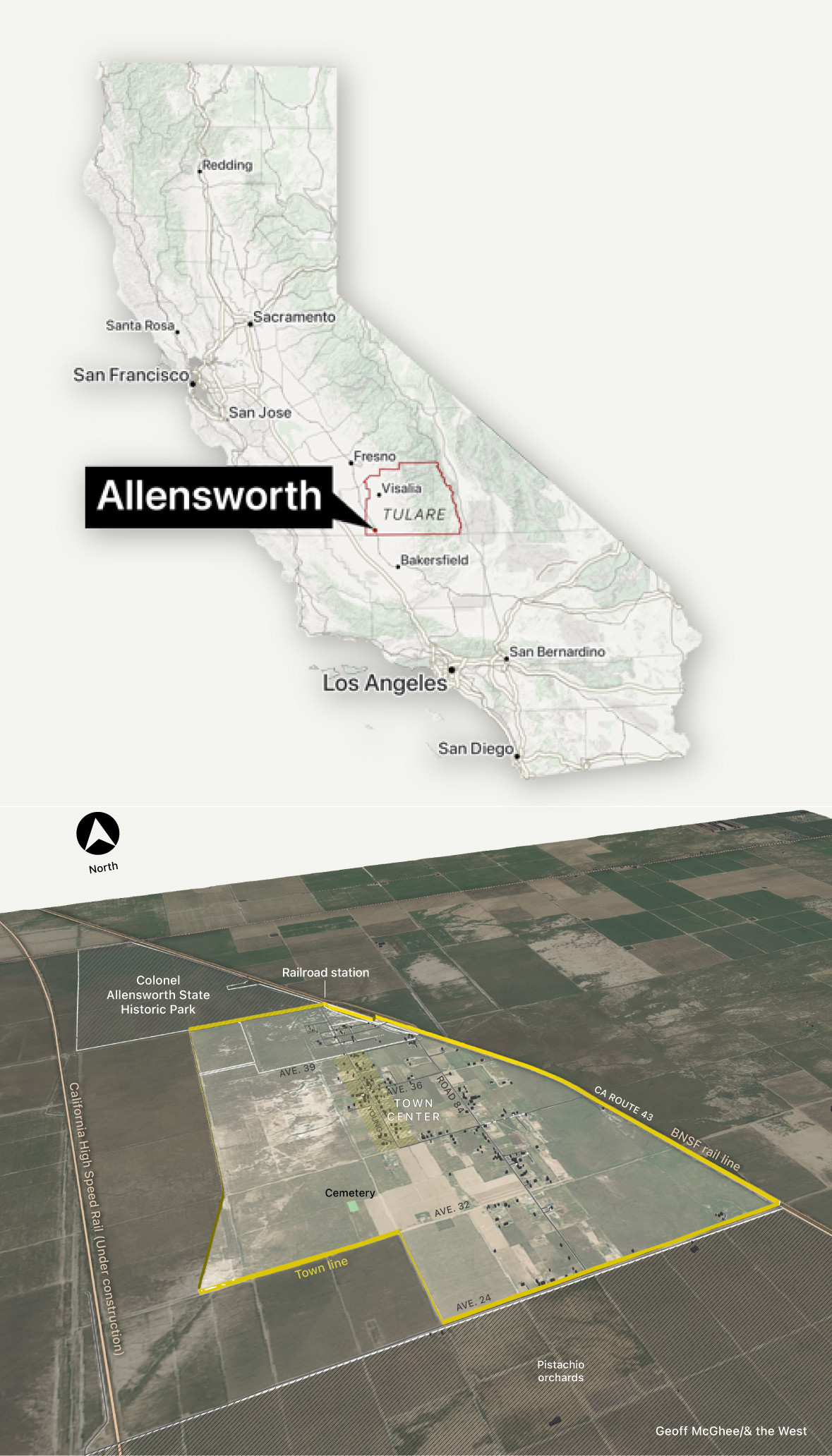
Few descendants of the original Black residents remain. In the early 2020s, 45 percent of residents made below-poverty wages and 13 percent of households got public assistance, the town plan says, though recent figures put the poverty rate at 12.4 percent. Either way, it’s an unprepossessing canvas on which to paint a new landscape. Another reason for doubt: fulfilling the goals of Allensworth’s new plan would cost tens of millions of dollars.
But optimists argue that Allensworth has already achieved what seemed unachievable. The state historic park itself is a minor miracle. Tulare County had planned a tax-lien sale of 12 properties giving outside ranchers control of much of the town. Ed Pope, a former resident, fought back. He and allies convinced the legislature to stop the erasure of Black history. The state parks agency bought 240 acres. The park opened in 1976: the past caught in amber.


“We are going to rebuild this town.”

For decades, the town’s future, under assault for 30 years, seemed as unpromising as its exhausted soil. From the 1970s through the 2000s Tulare County officials approved one noxious proposal after another for Allensworth. They didn’t know they faced a potent opponent: Nettie Morrison. She arrived in 1979, bringing all of the colonel’s determination and her own capacious vision of what Allensworth could be.
“We said, ‘Why would you move here when there’s nothing here?’”
– Sherry Hunter
After a visit to the new park in 1978, Morrison, then 44 and living further south in Wasco, moved here with her husband. Her grown children were bewildered. “We said, ‘Why would you move here when there’s nothing here?’” her daughter Sherry Hunter recalled. Morrison’s answer: “I want to be part of history. We are going to rebuild this town.”
“She saw more in it than just visually looking at it,” Hunter said. “She saw what it once was and what Col. Allensworth had started to create and she knew she could help it become that.”
Morrison, her daughter Denise Kadara said, lived in “a one-room house with a kitchen and living room and bathroom and hallway.” She sold baked goods to tourists visiting the park and raised money to move the historic Allensworth Christian Church out of the park and restore it. She worked on church projects, found food for neighbors who needed it, and started the Friends of Allensworth, creating programming for the new park.
To preserve her emerging vision, Morrison fought those who wanted to use the town as a dumping ground. After years of working with her neighbors, Morrison had a ready-made army to help her, and she enlisted her neighbors and her children to defend against toxic proposals.
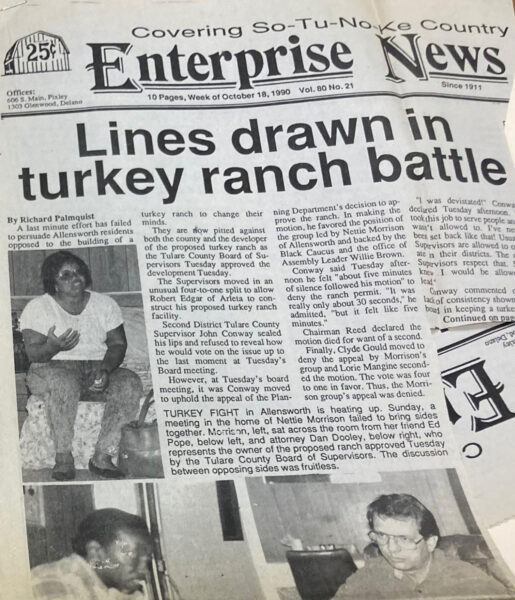
They blocked a 1980s plan for a grease pit full of fats and food particles that would have produced hydrogen sulfide and smelt like rotten eggs. In the 1990s, they stopped a proposed turkey farm, sparing the town from housing thousands of birds, whose guano would leach ammonia, producing a stinking brew of ammonium nitrate. “My mother said the smell would destroy the town,” said Sherry Hunter.
Then came the 2000s plan for two mega-dairies with 12,000 cows generating tons of manure on 320 acres next to the park. Morrison, whom residents had crowned the town’s honorary mayor, sounded the alarm. An anti-dairy bill was proposed. Scores of Black leaders excoriated the plan to county supervisors and at state legislative hearings. Eventually state officials paid the landowner $3.5 million to keep the town dairy-free.
“I don’t know how Nettie did it – I would almost say that the way the Colonel is treated is more appropriate for Nettie,” said Dezaraye Bagalayos, who for a decade has worked with the Allensworth Progressive Association. The APA had been the town’s original governing organization. Morrison reconfigured it in 1986 as a 501(c)(3) nonprofit. Ever since, the APA has driven the changes. “While she was doing the hard-core work in the living community and fighting off the dairies, Nettie absolutely led the charge,” Bagalayos said.
A flood threatens the town and spurs new resolve
In 2023, several years after Morrison’s death, it fell to Denise Kadara and other residents to fend off a more immediate threat – flooding after atmospheric rivers drenched the region in March of 2023. The fight against the floods created lasting bonds among residents.
When someone illegally cut the banks of a local creek to keep a rich farmer’s crop dry, floodwaters were diverted toward Allensworth. With flooding imminent, Denise Kadara, who is also a member of the Central Valley Regional Water Quality Control Board, made emergency calls to legislators and the governor’s office, as SJV Water reported, to try to make the farmer move a piece of equipment left in a spot that also forced floodwaters to Allensworth. “We didn’t get flooded because of rain. We got flooded because of farmers,” Tekoah said.

“We didn’t get flooded because of rain. We got flooded because of farmers.”
– Tekoah Kadara
The flooding was abated in part thanks to a new berm built for high-speed railroad tracks nearby. Other waters were blocked by townsfolk, who barely knew each other, working like mad. “Everybody got together. ‘Grab your shovel!,’ We were all trying to save our town. Men were digging ditches and setting up levees,” Efrain Sotelo said.
“The town really came together,” his wife, Carole, said. “That’s how we found out we could rely on our neighbors,” she said. “We almost got arrested together.” Efrain interjected. “We had to go to the north side of the park to build levees. Someone called the cops on us, said we were on private property. So we just got out of there. But if we hadn’t [created that levee], the first thing that would have been taken away [by the flood] would have been the park. Then our homes.”
An ongoing quest for safe drinking water

For decades, what no one could keep out of town was arsenic. In many rural areas of Tulare County, naturally occurring arsenic in the aquifer became more concentrated with overpumping. In 1966, state researchers found dangerous arsenic levels in Allensworth groundwater. Last year, U.C. Berkeley researchers found arsenic levels in groundwater from one agricultural well – not used for drinking – were 250 micrograms per cubic liter, about 25 times the EPA limit.
Tekoah Kadara pointed out that water with high arsenic levels consumed regularly causes cancer. For years, residents have driven to nearby Delano to buy bottled water.
In the 1980s, Morrison and community members campaigned for new wells producing water with greatly reduced arsenic levels. As a result, the state has two wells drilled three miles outside of the town center. The arsenic in both wells’ water was below the Environmental Protection Agency’s then-50 ppb standard. In 2008, when the EPA limit dropped to 10 ppb, water from the two wells was blended to comply with the limit. It doesn’t always do so.


For years, the California state water boards’ office has worked to get Allensworth a reliable supply of clean water, its effort delayed by a series of obstacles: problems finding the best site, drought, and endangered species issues. In 2021, Dimitri Stanich, a board spokesman, said, “the board … executed a funding agreement for a $3.8 million grant to … fully [fund] the drilling, construction, and development of a water-supply well with storage tank and booster pump….”
That grant goes to the Community Service District to reimburse the cost of contractors. It doesn’t reflect more than $2 million the water board spent for things like bottled water and planning assistance to help with Allensworth’s water troubles between 2014 and 2022.

The water board worked closely with Sherry Hunter, another of Nettie Morrison’s daughters. Hunter presides over the Community Services District, an independent government agency responsible for infrastructure. The decade-long wait is ending: a new well, costing about $1,962,000, and a holding tank, whose cost will consume much of the rest of the $3.8 million, are set to start operating within 18 months.
“After years of effort to achieve reliable access to safe and affordable drinking water, the town of Allensworth is nearing completion of the project,” Stanich said.
Allensworth rides the cutting edge of arsenic removal technology
As the well nears completion, so does a separate arsenic-removal project. It happened because Nettie Morrison’s children and the community members who have rallied around their vision inherited a skill she processed in abundance: getting attention that gets results.
In late 2017, just before Morrison’s death, Kayode Kadara assembled community leaders to meet with a group organized by Thomas Tomich, professor of sustainability science and policy and founder of the Food Systems Lab at the University of California, Davis. Among the group was Kat Taylor.
At the end of the meeting, Dennis Hutson said, “Tomich asked, ‘is there anything you want to ask of us?’” Kayode Kadara asked flippantly: “‘Do you know anyone who can get the arsenic out of our water?’” Tomich’s response: “ ‘I think I do.’ ” Within a month, Ashok Gadgil, a civil engineering professor at UC Berkeley, who had headed an arsenic-remediation initiative at Lawrence Berkeley National Lab, was on the phone.

Gadgil had worked extensively on arsenic removal collaborating with a university in Calcutta, India, to help a community whose water was badly contaminated with arsenic. He knew how to add iron to water to remove the arsenic chemically, but the method was slow and labor-intensive – it was affordably cheap in India, but would be too expensive at U.S. labor rates.
Gadgil has also experimented with a new method: using hydrogen peroxide, which speeded up the reaction ten-thousandfold. In 2019, his state-funded experiment proved arsenic removal from Allensworth’s groundwater could be fast and inexpensive. Since then, Gadgil and his colleagues have repeatedly been testing their technique on groundwater samples to be sure the new technology is reliable.
The new community plan recommends setting up kiosks incorporating Dr. Gadgil’s technology. “As far as the level of arsenic is concerned,” Tekoah Kadara said, “When we add the new technology to the water system, [levels] will be reduced to less than two ppb.” The APA, he said, has purchased the intellectual property from U.C. Berkeley. Hunter said,“If you want arsenic-free water, you’ll take an empty container to one of the kiosks with the technology provided by Gadgil, pay 25 cents and get arsenic-free water.”
Two other hurdles face her Community Services District. The first is getting a town sewer system, ending the days of septic fields and making Allensworth more attractive to developers.
The second: ensuring that the old town cemetery, once nearly obliterated as farmers dug into it, is made into a memorial park – a place not just for the original residents but, in time, for the current ones. The TomKat Ranch Educational Foundation donated $150,000 to that effort.


An extended family works with neighbors to improve water, soil, and agriculture

Denise Kadara, a retired city planner who had worked in the San Francisco Bay area, is now president of the Allensworth Progressive Association. The nonprofit, which has the same name as the original governing agency in Allensworth, organizes meetings of residents to discuss their needs and desires and works on several fronts.
Hutson, who is Denise’s twin brother, with her son Tekoah and the APA’s project manager, Jose Armando Munguia, have separate projects to bring regenerative agriculture to town. In 1980, Hutson, a pastor and farmer with a master’s degree in business, first visited his mother, Nettie Morison, in Allensworth. After briefly running church services from her home, he returned to other pulpits, then enlisted as an Air Force chaplain.
On his retirement, 37 years after his first visit, Hutson moved to Allensworth. With their retirement money, he and his wife, Patricia, bought 60 acres of land to set up an organic farming operation. “That ignited the work we are doing today,” said Denise Kadara. Hutson is now a pastor in nearby Porterville, but still farming in Allensworth.
During the pandemic, he needed help finding workers. Sri Sethuratnam, the California Farm Academy’s director, stepped in. Sethuratnam and the Center for Land Based Learning helped Hutson complete the state’s Healthy Soils Program. Separately, Sethuratnam helped the Allensworth Progressive Association win a $500,000 training grant to run a Beginning Farmer Training Program, now moved to a farm further south in Wasco.
Visions of agro-voltaics and regenerative farming take shape

The APA hopes to acquire 2,000 acres from a local pistachio farm south of town to use for regenerative agriculture, but nothing is certain. Tekoah Kadara and the APA’s farm manager, Jose Armando Munguia, have taken the lead in finding farmland to show an alternative approach to traditional farm operations.
Once land is acquired, the idea, Tekoah said, is to leave most of the trees in place and then “convert the orchard to a regenerative system – to stop using chemicals immediately, plant cover crops, and have diverse animals for grazing – goats, rabbits and cows.” Eventually solar panels might be installed to create an “agro-voltaic” project and connect to a microgrid feeding electricity to residents.

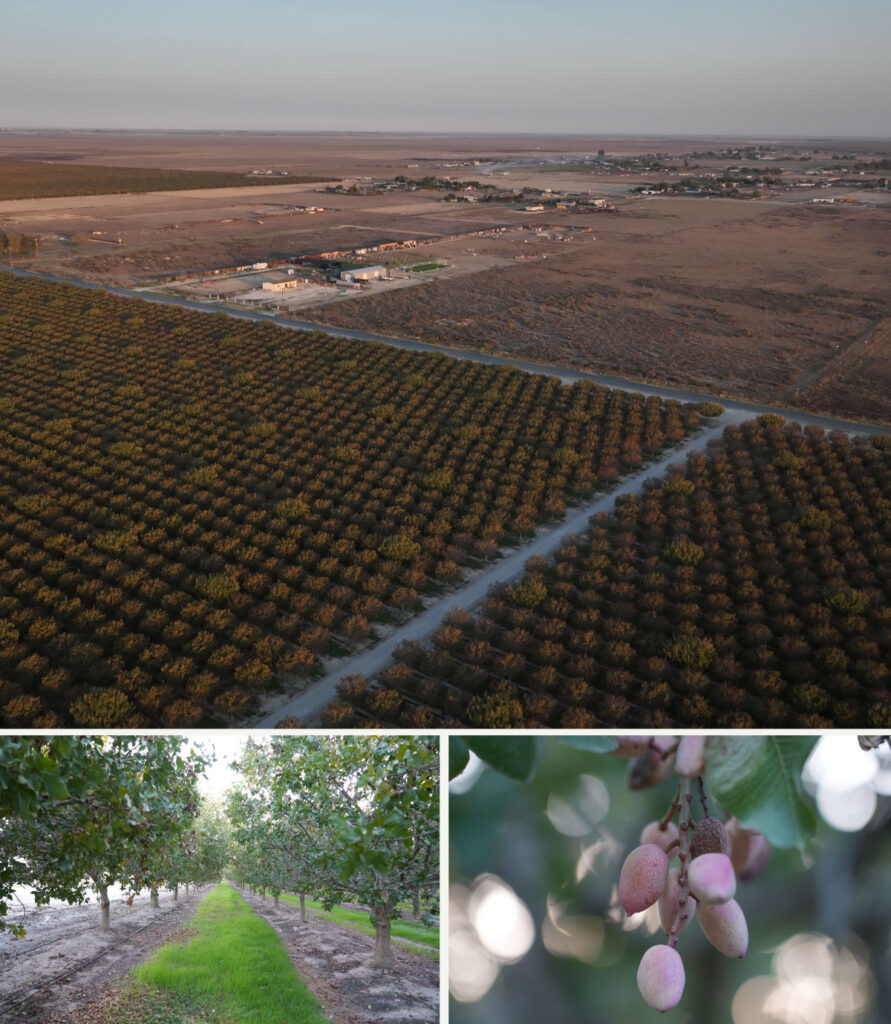
On both the existing farm and any new one, Muniguia said, the initial emphasis will be on returning the saline, compacted soil to health. “We are [creating] a diversified food system,” he said. “We have to increase the organic matter,” with rabbit manure, biochar, or compost. What crops will be grown? “It’s imperative that we include the community for design and implementation,” Muniguia said: what is grown will be things residents use in their kitchens – peppers, tomatoes, watermelon, beans, corn, and squash.
Kat Taylor has been bewitched by the town’s history and its ambitions. “I’ve been really interested in community economic development, especially when it’s community-led,” she said in an interview. “Against all odds, these people are going to get that done. …. They are tenacious. I’ll put myself in there too. We’re going to hold on till the money shows up and the opportunity arises, and the investability of the community becomes more apparent.”
Allensworth’s tiny school has doubled in size

In Allensworth’s early years, its school was a source of community pride. That was less true in recent years, when the five-member school board sometimes couldn’t muster a quorum for meetings that handled basic business, like paying salaries and debts.

Kayode Kadara, Denise’s husband, had recently retired from work as a postal service facilities manager when he moved to Allensworth in 2010. When he joined the board, the school, which goes from PreK through 8th grade, had just 63 students, barely enough to qualify for state assistance.
The problems with quorums for board meetings impacted school management. “We needed to make sure that dedicated employees doing the best for students got paid,” Kadara said. The fluctuating attendance at board meetings was matched by fluctuating student attendance. “People are coming and going – this is a migrant community,” Kadara said. “Students would show up at the beginning of the year and by the middle of the year they were gone.”
Attendance has doubled to about 153. “In the past six to seven years, additional people have moved into the community,” said Kadara, who believes some were drawn by Allensworth’s burgeoning reputation. He now wants to expand it into a 14-grade school, ending with two years of junior-college instruction.

It’s not just attendance that has grown. So has the school’s profile, thanks partly to the Allensworth Running Club, founded in 2023. Students enter regional, state, and national track meets, their successes echoing those of track athletes from another poor Central Valley town featured in the 2015 Disney movie “McFarland USA.” The Allensworth’s seven- and eight-year-old division girls’ team won a national title.
“Achieving Rural Self-Sufficiency”
People are noticing. Both NBC News and the Los Angeles Times have done video reports on the town’s successes. Allensworth’s latest plan predicts that it “will not need to rely on external support or be subjected to external governance in order to sustain itself economically, environmentally, and socially. Resources will be provided by and for the community…” The plan calls for medical and emergency services, as well as lighting and sidewalks.
How to pay for the renewal? Some expenses will be public, like a new sewer system. Others, like the land purchase, could cost at least $10 million. The APA’s ability to attract grants would need to accelerate. Still, it might be a mistake to sell their fundraising short.
Here’s how the APA’s financial picture has improved. Its tax return shows that at the end of 2021 the organization’s coffers totalled $68,288. A hint of a flusher financial future is reflected in its growing bank balance. The most recent tax records show that at the end of 2023, the APA had $9,549,293 in the bank, much of that reflecting a $10 million grant from the state at the end of 2022. Some $1,623,954 in grants arrived in 2023, including a $395,000 grant from the TomKat Ranch Educational Foundation.
That is part of a total of about $640,000 from the TomKat Foundation. Allensworth, Taylor believes, can be a “beacon of hope” demonstrating how a rural community can be transformed.
In 2023 the APA spent $1.3 million, mostly on contractors handling management issues for the array of new projects and business planning. The fundraising success continued in 2024 and 2025, when the APA received another $2 million in grants, with another large grant under discussion, Tekoah Kadara confirmed.
But 2000 acres of the pistachio farm could cost at least $10 million, if not more. Kat Taylor is convinced that, one project at a time, as the groundwork is laid, financing will follow. “You can’t lose if you never quit,” she said.
Dezaraye Bagalayos, an APA leader, said, “2026 is going to be a big year for us. The past three or four years have been insane in the best way possible. When I came on we had about $500 in the bank account. I look at the work we have done in the last four years. We have a staff of 10 full time people and folks on contract and a gang of consultants and vendors.”
Angel S. Fernández-Bou, a senior scientist at the Union of Concerned Scientists, posted his views on that organization’s blog. His takeaway: “I have worked on cropland repurposing for years and I know many stories from many communities. The case of Allensworth is one of the most inspiring I have seen.
“Any economic analysis like the one my colleagues and I did for the whole Central Valley of California will tell you the Allensworth plan will bring millions of dollars to the community, to the county, and to the state. … [it] will set a precedent for all other rural disadvantaged communities to replicate their success in becoming resilient, independent, and good rural communities to live in.”
Carol Sotelo is focused on the next generation. “The kids that live here now – it brings it all the more closer for us. Let’s make things better for kids. There’s no sidewalks. No store where they can buy a soda…. People have that in other communities. Here we don’t. The only way we’re going to do it is we have to go and get it.”

Edited by Geoff McGhee.

Rare earths mining takes a heavy toll. Is it worth moving mountains for a domestic supply?
Widely distributed but hard to disentangle, exotic elements are vital to green energy and military applications. For decades, China has dominated the dirty business of mining and processing rare earth ores. Two Mojave desert mines, one operating and one planned, may change that picture.

A Central Valley family’s quest to revive a historic Black town is the work of generations
In its early 20th century heyday, Allensworth, California was celebrated as a model of Black self-sufficiency; then came loss and a long decline. A new generation is bringing new ideas, new money, and ambitions for a model economic and environmental rural community.

Thirsty for power and water, AI-crunching data centers sprout across the West
With promises of jobs and hopes for tax breaks, server farms are reshaping local grids, plumbing, and politics. Are they a boon for communities, or a burden?

Ketchikan calls itself ’Salmon Capital of the World.’ Does the title still fit?
Long since fish canneries built Southeast Alaska’s signature town, the trade is now being used to attract tourists.

Urban, rural and tribal: how three Wests diverge on cannabis
The West led the charge to legalize marijuana. As it becomes big business in many cities and towns, some others view it with distaste grounded in moral qualms or concerns about criminal cartels. Will growing revenues help sweeten the pot?

Idaho is increasingly a bullseye for Californian migrants
The state has gone from being an also-ran in the population sweepstakes to the country’s fastest-growing.